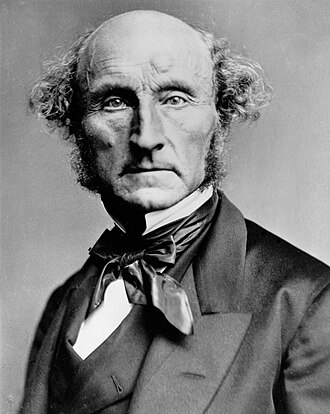
Born in London in 1806, John Stuart Mill was subjected by his father, James Mill, to an extraordinarily precocious and rigorous education — designed by Bentham’s circle to form a utilitarian thinker: he learned Greek at the age of three and devoured the classics and economics in childhood. At twenty he suffered a profound existential crisis, from which he recovered partly through Romantic poetry — an experience that led him to correct the arid utilitarianism in which he had been raised. He was also an economist, a Member of Parliament, and the intellectual companion of Harriet Taylor. He became the most influential liberal of the nineteenth century.
In ethics, Mill refines Bentham’s utilitarianism: the good is the greatest happiness of the greatest number, but happiness is not measured by the quantity of pleasure alone. There are higher pleasures (intellectual, moral, aesthetic) and lower ones, and the former are worth more — “it is better to be a Socrates dissatisfied than a fool satisfied.”
His most famous political work, On Liberty (1859), formulates the harm principle: the only legitimate reason to limit a person’s freedom is to prevent them from harming others; over himself, each individual is sovereign. Hence his passionate defense of freedom of expression — even false opinions should circulate, for truth is strengthened only in confrontation. A pioneer too of liberal feminism (The Subjection of Women, 1869), Mill shaped modern liberalism, the philosophy of law, and the debates about individual autonomy that remain alive to this day.
Key Concepts
- Qualitative utilitarianism: against Bentham, Mill distinguishes higher pleasures (intellectual, moral) from lower ones (physical) — “It is better to be Socrates dissatisfied than a fool satisfied”
- Principle of utility: the correct action is the one that produces the greatest happiness for the greatest number — but happiness is more than mere pleasure
- Harm principle (On Liberty, 1859): the only legitimate limit to individual freedom is preventing harm to others; society cannot coerce the individual for their own good
- Freedom of expression: free debate is essential — even wrong opinions contribute to testing and strengthening truths; censorship is always harmful
- Induction and logic: A System of Logic (1843) — methodology of the sciences; the five canons of inductive method (agreement, difference, concomitant variation, etc.)
- Feminism: The Subjection of Women (1869) — defends legal and political equality between the sexes with liberal arguments
Influenced by
- Bentham — utilitarianism (but critiques and deepens it)
- Locke and Rousseau — freedom and rights
- Kant — morality and dignity (indirect influence)
- Samuel Taylor Coleridge — romanticism and critique of vulgar utilitarianism
- Harriet Taylor — intellectual partner, influence on feminism
Influenced
- Modern political liberalism
- Habermas — public sphere and rational debate
- Liberal feminism (Betty Friedan)
- Philosophy of law and bioethics (harm principle)
Works
A System of Logic (1843); Principles of Political Economy (1848); On Liberty (1859); Utilitarianism (1863); The Subjection of Women (1869).
See also
Philosophy of the Nineteenth Century