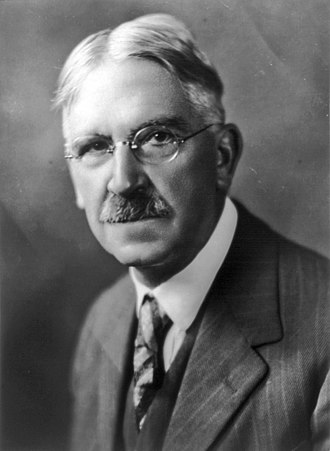
American philosopher, the greatest exponent of pragmatism in the 20th century. He reformulated pragmatism as instrumentalism: knowledge is an instrument for solving practical problems. A philosopher of democracy and education, he exerted monumental influence on modern pedagogy.
Trained in the atmosphere of Hegelian idealism that dominated North American academic philosophy in the late nineteenth century, Dewey gradually moved away from that starting point as he absorbed Darwin’s evolutionary naturalism and the experimental method of the natural sciences. The decisive turn came during his years at the University of Chicago, where he founded a laboratory school designed to test, in educational practice, his ideas about the continuity between thought and action. From that experience grew the conviction at the heart of his entire work: that the separation between theory and practice, between knowing and doing, is an error inherited from a philosophical tradition that privileged contemplation over living experience. For Dewey, thinking is not the mirroring of a ready-made world but an intervention in it, a way of reorganizing situations that have become problematic.
This project issues in a reconstruction of philosophy that rejects both naive empiricism and abstract rationalism, proposing in their place a theory of inquiry modeled on the scientific method. Equally important is the social dimension of this thought: Dewey understands democracy not as a mere institutional arrangement but as the moral environment in which collective intelligence can grow through free communication and cooperation. His long career of public engagement — in debates over education, liberalism, science, and art — made him one of the most influential intellectual voices in the United States, and his legacy remains alive both in contemporary pedagogy and in the neopragmatism that revived and renewed his theses in the second half of the twentieth century.
Key Concepts
- Instrumentalism: ideas, theories, and concepts are instruments or tools for solving concrete problems — not mirrors of reality, but means of effective action
- Experience as transaction: experience is not passive reception of data, but an active transaction between organism and environment — subject and object mutually transform each other
- Learning by doing: education must begin with concrete experience and real problems, not with passive transmission of content
- Democracy as a way of life: democracy is not merely a system of government, but a cooperative way of life based on communication and participation — “a democracy is more than a form of government; it is primarily a mode of associated living”
- Inquiry: the scientific method generalized as a logic of problem-solving — from the problematic situation to hypothesis, experimentation, and re-establishment of equilibrium
- Naturalism: mind, morality, and culture are natural phenomena — rejection of all Cartesian dualisms between mind/body, subject/object, theory/practice
- Reconstruction in philosophy: philosophy must abandon pseudo-problems (mind vs. matter, being vs. becoming) and devote itself to real human problems — social, educational, political
Influenced by
- Hegel — dialectical integration, but without absolute idealism
- William James — pragmatism, stream of consciousness
- Peirce — logic of inquiry
- Darwin — evolutionary naturalism
Influenced
- Progressive pedagogy worldwide (New School movement)
- Habermas — deliberative democracy and communication
- Richard Rorty — neopragmatism
- American analytic philosophy (Quine, Davidson)
Works
Democracy and Education (1916); Reconstruction in Philosophy (1920); Experience and Nature (1925); The Quest for Certainty (1929); Logic: The Theory of Inquiry (1938); Experience and Education (1938).
See also
Twentieth-Century Philosophy