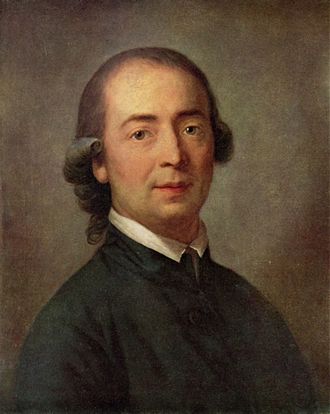
Johann Gottfried Herder (1744–1803) was born in Mohrungen, East Prussia, the son of a Lutheran schoolteacher and cantor, in a pietist household that shaped his religious sensibility and his lasting interest in language and popular culture. In 1762 he enrolled at the University of Königsberg, where he attended the lectures of Kant — then a young Privatdozent (an untenured lecturer without a chair), still far from the critical philosophy that would make his name — and formed a decisive friendship with Johann Georg Hamann, who instilled in him a deep suspicion of abstract rationalism and an enduring interest in the relationship between language, thought, and faith. Between 1764 and 1769 he worked as a schoolteacher and pastor in Riga, a cosmopolitan Baltic port that sharpened his interest in the diversity of languages and popular customs. A sea voyage to France in 1769, recorded in the Journal meiner Reise im Jahre 1769, and his meeting with the young Goethe in Strasbourg in 1770, drew him into the nascent Sturm und Drang movement. In 1776, at Goethe’s invitation, he took up the post of general superintendent (court preacher) in Weimar, where he remained until his death in 1803, forming with Goethe, Schiller, and Wieland the circle later known as Weimar Classicism.
Herder’s work spans the philosophy of language, aesthetics, theology, and the philosophy of history, but it is in the last of these that he left his most lasting mark. Already in the Abhandlung über den Ursprung der Sprache (Treatise on the Origin of Language, 1772), which won the Berlin Academy prize, he argued that language is not a divine gift but a natural human capacity — the fruit of human “reflection” (Besonnenheit) — and that thought and language are inseparable: each language expresses and shapes its own way of seeing the world. In Auch eine Philosophie der Geschichte zur Bildung der Menschheit (Yet Another Philosophy of History for the Formation of Humanity, 1774), he mounted his sharpest attack on the Enlightenment: against the idea of a linear, universal progress measured by the European standard of the present, Herder insisted that every age and every people (Volk) possesses its own worth and meaning, not to be subordinated to an external criterion of perfection. This pluralist intuition matured in the major work of his later years, the Ideen zur Philosophie der Geschichte der Menschheit (Ideas for a Philosophy of the History of Humanity, 1784–1791, in four parts), in which Herder treats human development as an organic process shaped by climate, geography, and each people’s culture, and argues — in terms critical of European colonialism — that understanding a culture must proceed from its own terms rather than from a single civilizational canon.
Herder was also decisive in elevating popular poetry and song as expressions of the distinctive “genius” or spirit of each people — work gathered in the Volkslieder (Folk Songs, 1778–1779) — an idea that, under the term later consecrated as Volksgeist in German Romanticism and the Historical School of Law, would feed both the Brothers Grimm’s collection of folk tales and currents of nineteenth-century cultural nationalism. His relationship with Kant, initially one of discipleship, soured with maturity: Herder published a frontal attack on Kant’s critical philosophy in the Metakritik zur Kritik der reinen Vernunft (Metacritique of the Critique of Pure Reason, 1799) and, the following year, in Kalligone (1800), assailed the Kantian aesthetics of the Critique of Judgment.
Key Concepts
- Cultural pluralism and the critique of Enlightenment universalism: every people and every age has its own center of value, irreducible to a single European standard of progress — the central thesis of Auch eine Philosophie der Geschichte (1774).
- Historical organicism: human development is conceived by analogy with organic growth, shaped by climate, geography, and culture — the axis of Ideen zur Philosophie der Geschichte der Menschheit (1784–1791).
- Language and thought: against the thesis of a divine origin of language, Herder argues, in the Abhandlung über den Ursprung der Sprache (1772), that it arises from the natural human capacity for reflection (Besonnenheit) and that each language shapes a distinctive way of conceiving the world.
- The “genius of a people” and Volksgeist: the idea that every people (Volk) has a collective character and soul, expressed above all in its language and popular poetry — a notion Herder articulated under expressions such as “the genius of a people,” which only later, in Romanticism and the German Historical School of Law, crystallized under the term Volksgeist.
- Critique of colonialism and European ethnocentrism: in the Ideen, Herder condemns the abuses of European colonization and argues that every culture must be understood by its own internal criteria.
Influenced by
- Kant — Herder’s teacher at Königsberg, though their relationship turned to open criticism as both men matured
- Johann Georg Hamann — Herder’s intellectual mentor at Königsberg; the suspicion of abstract rationalism and the emphasis on language as the matrix of thought
- Rousseau — the critique of the artificiality of civilization and the valuing of feeling and nature as sources of authenticity
- Montesquieu — attention to climate and geography as factors shaping the character of peoples and their institutions
- Leibniz — the idea that each monad (and, by extension, each people) expresses the universe from a unique and irreplaceable point of view
Influenced
- Wilhelm von Humboldt — the philosophy of language as the expression of each people’s worldview (Weltansicht)
- The Brothers Grimm and German Romanticism — the valuing of folk song and folk tale as repositories of a people’s spirit
- Hegel — the philosophy of history as a process of development, though Hegel criticized Herderian cultural relativism in the name of a universal reason in history
- Nineteenth-century German historicism (Ranke, Dilthey) — the idea that every age must be understood on its own terms
- Isaiah Berlin — in Vico and Herder (1976), read Herder as a source of value pluralism and cultural “expressivism”
Works
Fragmente über die neuere deutsche Literatur (1767–1768); Kritische Wälder (1769); Abhandlung über den Ursprung der Sprache (1772); Auch eine Philosophie der Geschichte zur Bildung der Menschheit (1774); Volkslieder / Stimmen der Völker in Liedern (1778–1779); Ideen zur Philosophie der Geschichte der Menschheit (1784–1791); Briefe zur Beförderung der Humanität (1793–1797); Metakritik zur Kritik der reinen Vernunft (1799); Kalligone (1800).
See also
Kant, Hegel, Rousseau, Montesquieu, Isaiah Berlin