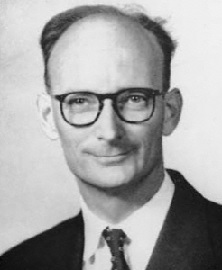
John Langshaw Austin (26 March 1911, Lancaster — 8 February 1960, Oxford) was a British philosopher, a central figure of Oxford ordinary language philosophy. White’s Professor of Moral Philosophy, he played a distinguished role in British military intelligence during the Second World War. He published little in his lifetime; his decisive works are posthumous, reconstructed from lectures and papers. His style was patient, anti-systematic, and attentive to fine detail: for Austin, “our common stock of words embodies all the distinctions men have found worth drawing” across many generations — and philosophy should begin by examining them.
Key Concepts
- Performatives and constatives (How to Do Things with Words, 1962, based on the 1955 William James Lectures): not every utterance describes the world. Constatives state something, and may be true or false; performatives do not describe — they perform an action in being said: “I promise…,” “I name this ship…,” “I do” (in marriage). Performatives are neither true nor false but felicitous or infelicitous, depending on whether they meet the felicity conditions (the right person, the proper procedure, sincerity).
- Speech act theory: Austin ends by dissolving his own distinction and generalizing — all saying is a doing. Every utterance simultaneously performs three acts: the locutionary act (saying something with sense and reference), the illocutionary act (what one does in saying it: promising, warning, ordering — the illocutionary force), and the perlocutionary act (the effects produced by saying it: persuading, frightening, consoling).
- Critique of sense-data (Sense and Sensibilia, 1962, posthumous): against the thesis that we perceive “sense-data” directly rather than material things (his target: A. J. Ayer), Austin shows that the argument rests on a misuse of ordinary words like “looks,” “appears,” and “illusion.”
- “Linguistic phenomenology” (“A Plea for Excuses,” 1956): examining the fine distinctions ordinary language draws — for instance, doing something “by mistake” versus “by accident” — is a guide to the phenomena themselves, not mere word-study.
- “How do you know?” (“Other Minds,” 1946): to say “I know” is not to report a private mental state but something closer to giving one’s word — committing one’s authority before others, as in a promise.
Influenced by
- Wittgenstein — attention to use, though Austin worked independently
- G. E. Moore — common sense and careful analysis
- The realist and analytic tradition of Oxford
Influenced
- Searle — the systematization of speech act theory (Speech Acts, 1969)
- Paul Grice — the theory of implicature and communication
- Derrida — the debate over the iterability of the performative (the Searle–Derrida exchange)
- Judith Butler — the notion of gender performativity (via Austin and Derrida)
Works
How to Do Things with Words (1962, posthumous); Sense and Sensibilia (1962, posthumous); Philosophical Papers (1961), gathering essays such as “A Plea for Excuses,” “Other Minds,” and “Truth.”
See also
Wittgenstein, Searle, Derrida