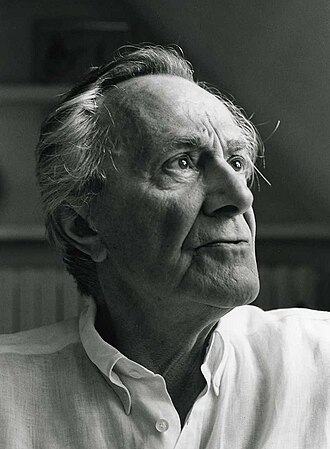
Jean-François Lyotard (10 August 1924, Versailles — 21 April 1998, Paris) was a French philosopher, one of the central voices in the debate over postmodernity. Trained in philosophy at the Sorbonne, he taught at the lycée of Constantine in colonial Algeria, an experience that shaped his political engagement. Over his career he taught at Nanterre, at the experimental University of Vincennes (Paris VIII), and later at North American universities; he was closely associated with the Collège international de philosophie (founded in 1983 by Derrida, Châtelet, Faye, and Lecourt), which he went on to direct from 1984 to 1986.
His path runs through several phases. In the 1950s and 1960s he was a militant of the revolutionary Marxist group Socialisme ou Barbarie and wrote extensively on the Algerian war, before breaking with orthodox Marxism. There followed a phase critical of the primacy of language (Discourse, Figure, 1971) and a Nietzschean-Freudian foray into desire (Libidinal Economy, 1974, which he himself called his “evil book”). International fame came with The Postmodern Condition (1979), but his philosophically densest work is The Differend (1983).
The problem that occupies him is that of legitimation: what authorizes a body of knowledge, a norm, a judgment, once the grand narratives that used to ground them have lost their credibility? His answer refuses both the relativism of “anything goes” and the nostalgia for a lost foundation: the task is to think justice and invention amid the irreducible plurality of ways of speaking.
Key Concepts
- Metanarrative and incredulity: he defines the postmodern as “incredulity toward metanarratives” (The Postmodern Condition, 1979). The great modern stories — Enlightenment emancipation, the realization of the Hegelian Spirit, Marxist liberation — have lost the power to legitimate knowledge.
- Language games: borrowing the term from Wittgenstein, he holds that knowledge is divided into heterogeneous games, each with its own rules, incommensurable with one another. There is no meta-game to totalize them.
- Performativity: in the computerized society, knowledge tends to legitimate itself by efficiency (the best ratio of means to ends) and to become a commodity, threatening free inquiry.
- Paralogy: against legitimation by consensus, he prizes the innovative move, productive dissent, the invention of new rules.
- Differend (Le Différend, 1983): a conflict between two parties that cannot be judged equitably for lack of a common rule; the wrong done to one of them finds no idiom in which to be expressed, and the victim is silenced. Ethics consists in bearing witness to the differend.
- The figural and the sublime: from the desire that escapes discourse (Discourse, Figure) to the Kantian sublime — presenting that there is the unpresentable — Lyotard links the postmodern to avant-garde art.
Influenced by
- Kant — reflective judgment and the sublime
- Wittgenstein — language games
- Karl Marx and Sigmund Freud — critique and the economy of desire (early phase)
- Nietzsche — the critique of universal truths
Influenced
- The philosophical and cultural debate over postmodernity
- Contemporary aesthetics and the theory of the avant-gardes
- The political philosophy of difference and the reflection on justice without prior criteria
Works
Discourse, Figure (1971); Libidinal Economy (1974); The Postmodern Condition (1979); The Differend (1983); The Inhuman (1988); Lessons on the Analytic of the Sublime (1991).
See also
Jacques Derrida, Foucault, Jean Baudrillard