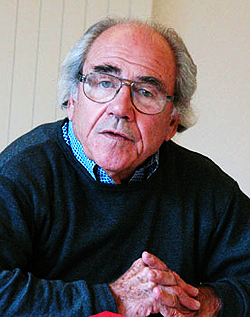
Jean Baudrillard (27 July 1929, Reims — 6 March 2007, Paris) was a French sociologist, philosopher, and cultural theorist, known above all for his theory of the simulacrum and the hyperreal. Trained in German studies, he began his career as a teacher of German and a translator — he rendered into French texts by Bertolt Brecht and Peter Weiss, among others. From 1966 he taught sociology at Nanterre (Paris X), the epicenter of the May 1968 unrest, under the influence of Henri Lefebvre and Roland Barthes.
His work begins with a critical analysis of consumption. In The System of Objects (1968) and The Consumer Society (1970), he shows that in contemporary society objects are consumed not for their usefulness but as signs that mark status and difference within a code. Crossing Marxism with semiology, he coins the notion of sign-value, alongside use-value and exchange-value. In The Mirror of Production (1973), however, he breaks with Marxism: for him, Marx had remained a prisoner of the “productivism” of political economy, unable to think forms of exchange alien to labor and utility — such as the symbolic exchange of the gift and of sacrifice, inspired by Marcel Mauss and Georges Bataille.
From Symbolic Exchange and Death (1976) and, above all, Simulacra and Simulation (1981) onward, Baudrillard develops his most influential — and most controversial — thesis: that we live in an era in which the real has been replaced by its models. This is the hyperreal.
Key Concepts
- Simulacrum and simulation: to simulate is not to represent an existing reality but to generate it from models. The simulacrum is a copy without an original, “true” in its own right.
- Hyperreal: the real produced by models, “more real than the real,” without origin or reference. The borders between reality and representation implode.
- Precession of simulacra: inverting Borges’s fable, “the map precedes the territory” — the model comes before the thing it is supposed to copy.
- The four phases of the image: the image (1) reflects a profound reality; (2) masks and perverts that reality; (3) masks the absence of a reality; (4) bears no relation to any reality whatsoever — it is its own pure simulacrum.
- Sign-value: the consumer object signifies before it serves; we consume the difference it inscribes within a social code.
- The hyperreal war: in The Gulf War Did Not Take Place (1991), he argues — without denying the deaths — that the war was experienced as a pre-programmed media event, “won in advance” on the screens.
Influenced by
- Henri Lefebvre and Roland Barthes — the critique of everyday life and semiology
- Karl Marx — political economy (later criticized)
- Marcel Mauss and Georges Bataille — the gift and symbolic exchange
- Marshall McLuhan — the theory of the media
Influenced
- The theory of media, communication, and cultural studies
- Contemporary art and cyberculture
- Pop culture (The Matrix features Simulacra and Simulation, though Baudrillard judged the film a misunderstanding)
Works
The System of Objects (1968); The Consumer Society (1970); The Mirror of Production (1973); Symbolic Exchange and Death (1976); Simulacra and Simulation (1981); America (1986); The Gulf War Did Not Take Place (1991).
See also
Jean François Lyotard, Roland Barthes, Foucault