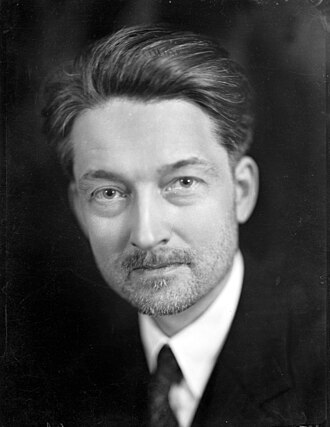
Jacques Maritain was born in Paris on 18 November 1882 and died in Toulouse on 28 April 1973. Raised in a liberal Protestant, republican household, he studied at the Sorbonne, where he met Raïssa Oumançoff, whom he later married, and attended the lectures of Henri Bergson at the Collège de France; he also studied biology in Germany under Hans Driesch. In 1906, under the influence of Léon Bloy, he converted to Catholicism and went on to study Thomas Aquinas, whose thought he defended as a “perennial philosophy” able to engage with modernity. He taught at the Institut Catholique de Paris and later in the United States and Canada, served as French ambassador to the Holy See (1945–1948), and held a professorship at Princeton. In his last years he lived in Toulouse with the Little Brothers of Jesus, whom he joined in 1970.
In the 1920s Maritain was close to the Action Française of Charles Maurras; Rome’s condemnation of the movement in 1926 led him to break with it and to reorient his political thought toward the defense of democracy and of the human person.
Key Concepts
- To distinguish in order to unite — the methodological principle of The Degrees of Knowledge (Distinguer pour unir ou Les degrés du savoir, 1932): the forms of knowledge (empirical-mathematical science, philosophy of nature, metaphysics, theology, mystical experience) have their own objects and methods, yet are ordered in a hierarchy without being confused.
- Integral humanism — the project set out in Humanisme intégral (1936) of a plural, democratic temporal order inspired, but not imposed, by Christianity, opposed both to modern anthropocentric humanism and to the medieval regime of Christendom.
- Person and common good — a Thomist-inspired distinction between the individual (the material aspect, a part of society) and the person (the spiritual dimension, ordered to ends that transcend the state), developed in The Person and the Common Good (1947).
- Natural law and human rights — in Les droits de l’homme et la loi naturelle (1942) and Man and the State (1951), he grounds human rights in natural law, arguing that practical agreement on rights is possible among people who disagree about their theoretical justification.
- Creative intuition — in Art et scolastique (1920) and Creative Intuition in Art and Poetry (1953), a Thomist reflection on art as a virtue of the practical intellect and on poetic experience.
On the Universal Declaration of Human Rights
Maritain is often described as an “author” of the 1948 Declaration; this is an overstatement. Drafting belonged to the UN Commission on Human Rights, and Maritain did not take part in it directly. His contribution lies in the UNESCO context: he took part in the 1947 General Conference in Mexico City and wrote the introduction to UNESCO’s collective volume on the philosophical foundations of human rights (1949), where he formulated the idea of practical agreement without theoretical agreement. How far he influenced the final text remains a matter of scholarly debate.
Influenced by
- Thomas Aquinas and the Thomist commentators, especially John of St. Thomas
- Henri Bergson, whose lectures he attended, though he later criticized aspects of his philosophy
- Léon Bloy and Charles Péguy, through religious and literary experience
- Humbert Clérissac, the Dominican who was his spiritual director
Influenced
- French and North American Neo-Thomism, with Étienne Gilson as an interlocutor and, on some questions, a dissenter
- The personalism of Emmanuel Mounier, close on many themes though distinct
- Catholic social teaching and the tradition of European and Latin American Christian democracy
- Through the message to “men of thought and science” delivered at the close of the Second Vatican Council (1965), his name became associated with the Church’s dialogue with modern culture
Works
Art et scolastique (1920); Trois réformateurs (1925); Distinguer pour unir ou Les degrés du savoir (1932); Humanisme intégral (1936); Les droits de l’homme et la loi naturelle (1942); La personne et le bien commun (1947); Man and the State (1951); Creative Intuition in Art and Poetry (1953); Le paysan de la Garonne (1966).
See also
Antonin Sertillanges, Joseph Maréchal, Étienne Gilson, Emmanuel Mounier, Gabriel Marcel, Edith Stein