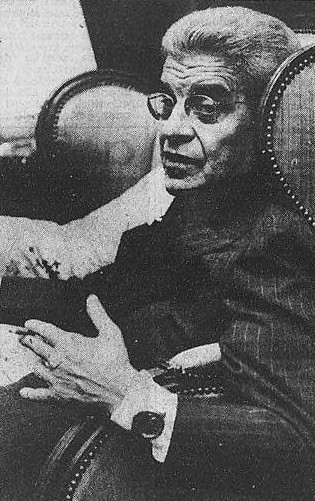
Jacques Lacan (13 April 1901, Paris — 9 September 1981, Paris) was a French psychoanalyst and psychiatrist, the most influential figure in psychoanalysis after Freud and a decisive link between psychoanalysis and structuralism. Under the banner of the “return to Freud,” he proposed rereading the Freudian discovery in light of the linguistics of Ferdinand de Saussure and the anthropology of Lévi Strauss, purging it of the biologism and ego-psychology he saw as betrayals. His Seminar, held from 1953, and his Écrits (1966) became an inescapable — and notoriously difficult — reference. After breaking with the International Psychoanalytical Association in 1963, he founded the École freudienne de Paris the following year, only to dissolve it himself in 1980.
Key Concepts
- The mirror stage (1936, reworked in 1949): between 6 and 18 months, the child jubilantly identifies with its reflected image, anticipating a bodily unity it does not yet possess. The ego (moi) is thus born of an alienating identification with an exterior image — the subject is split from the very start.
- The unconscious is structured like a language: Lacan’s most famous thesis. The unconscious is not a reservoir of instincts but operates according to the laws of the signifier. Rereading Freud with Saussure and Jakobson, Lacan reads condensation as metaphor and displacement as metonymy.
- Primacy of the signifier: Lacan inverts the Saussurean sign and holds that the signifier “slides” over the signified, separated from it by a bar. Meaning never fully fixes itself; the subject is “represented by one signifier for another signifier.”
- The three registers: Imaginary, Symbolic, and Real. The Imaginary is the order of images and identifications; the Symbolic is the order of language, law, and the big Other; the Real is what resists symbolization, the impossible-to-say. The three are knotted together (Lacan later thinks them as a Borromean knot).
- The Name-of-the-Father and desire: entry into the symbolic order passes through the paternal function (the Name-of-the-Father), which institutes law and prohibition. “Man’s desire is the desire of the Other”: we desire from and toward the Other. The objet petit a is the ever-missing cause of desire.
Criticism and controversy
Lacan’s work draws persistent objections: the deliberate obscurity of his style; his use of mathemes, topology, and knots (attacked by Alan Sokal and Jean Bricmont as a misuse of mathematics); and the variable-length sessions that triggered his institutional break. Even so, his influence on Continental philosophy has been immense.
Influenced by
- Freud — the source to which Lacan claims to “return”
- Ferdinand de Saussure and Roman Jakobson — signifier, metaphor, and metonymy
- Lévi Strauss — symbolic efficacy and the order of the Symbolic
- Hegel (read through Alexandre Kojève) — desire, recognition, the Other
Influenced
- Louis Althusser — the theory of ideological interpellation
- Slavoj Žižek and the contemporary renewal of critical theory
- Julia Kristeva and Luce Irigaray (in dialogue and critique)
- Film theory, political theory (Laclau and Mouffe), and literary theory
Works
Écrits (1966); The Seminar (published in volumes from the 1970s, esp. Book XI, The Four Fundamental Concepts of Psychoanalysis, 1973). His doctoral thesis On Paranoid Psychosis in Its Relations to the Personality (1932) precedes the structuralist turn.
See also
Freud, Ferdinand de Saussure, Louis Althusser