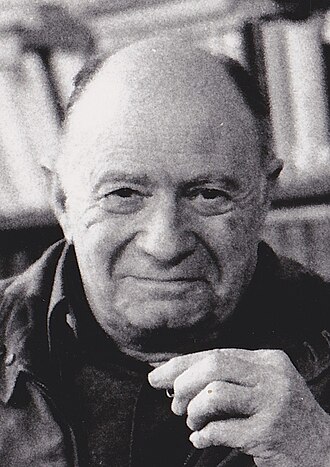
Jacques Ellul was born in Bordeaux, France, on 6 January 1912, and died in Pessac, in the Bordeaux metropolitan area, on 19 May 1994. Trained in law, history, and sociology, he spent decades as professor of the History and Sociology of Institutions at the Faculty of Law and Economic Science of the University of Bordeaux. In 1932 he underwent what he described as a “very brutal, very sudden” religious conversion, an episode that led him to join the Reformed Church of France and to sustain, throughout his life, a body of work he insisted must be read dialectically as two poles of a single thought: the sociological analysis of modern technique and Christian theological reflection. During the Second World War he took part in the French Resistance; in 2001, seven years after his death, he was recognized by Yad Vashem as “Righteous Among the Nations” for having helped Jews escape Nazi persecution.
Ellul is best known for La Technique ou l’enjeu du siècle (1954; English translation The Technological Society, 1964), in which he coined the central concept of his sociology: technique (la technique) — not isolated artifacts or machines, but “the totality of methods rationally arrived at and having absolute efficiency in every field of human activity.” For Ellul, modern technique had become an autonomous system, self-augmenting and imposing itself on every sphere of life — economy, politics, education, leisure — according to its own logic of efficiency, regardless of the moral ends human beings might wish to impose on it: human beings no longer master technique but are instead shaped and absorbed by it. In Le Système technicien (1977; English The Technological System, 1980), Ellul deepened this thesis, describing technique as a closed system that integrates and subordinates every particular technical subsystem. In Propagandes (1962), he extended the analysis to mass communication, showing how modern propaganda functions as a mechanism of psychological adaptation of the individual to the technical society, producing a kind of “hypnosis” that neutralizes genuine choice.
Key Concepts
- Technique (la technique) — not specific equipment or technologies but the totality of rationalized methods that pursue maximum efficiency in every domain of human action; the central concept of La Technique ou l’enjeu du siècle (1954).
- Autonomy of technique — the thesis that the modern technical system follows its own logic of self-expansion and self-regulation, independent of the moral, political, or religious values human beings might wish to impose on it.
- Self-augmentation and universalism of technique — technique develops through automatic progression (each technical advance generates the conditions for the next) and tends toward universalization, penetrating every culture and social sphere.
- Propaganda as social hypnosis — in Propagandes (1962), Ellul describes mass propaganda not as crude lying but as a sophisticated mechanism of psychological adaptation that neutralizes the critical judgment of the modern individual.
- Dialectical method — Ellul insisted that his sociology of technique (indebted to Marx) and his theology (indebted to Kierkegaard and Barth) form two poles of a single dialectical thought: sociological diagnosis without theological hope would be nihilistic; theological hope without sociological diagnosis would be naive.
Influenced by
- Karl Marx — method of sociological and historical critique of power structures; by Ellul’s own account, alongside Kierkegaard, one of only two authors whose complete works he read, though he rejected orthodox economic determinism
- Søren Kierkegaard — source of his anthropology of anxiety and of the paradoxical nature of faith
- Karl Barth — Protestant dialectical theology, the foundation of Ellul’s theological hermeneutics
- Lewis Mumford — Ellul discusses and critiques the theses of Technics and Civilization (translated into French in 1950) in La Technique ou l’enjeu du siècle
Influenced
- Neil Postman — Technopoly (1992) and other works on technological culture are explicitly indebted to Ellul’s concept of autonomous technique
- The International Jacques Ellul Society (founded in 2000) and the ongoing academic reception of his sociology of technique
- Contemporary debate on the ethics of technology, alongside voices such as Ivan Illich and Marshall McLuhan, with whom Ellul belongs to the same critical generation of technological society
- Controversial reception: his theses on the autonomy of technique were cited, polemically and without any endorsement from the author, in Theodore Kaczynski’s manifesto (1995) — an episode frequently discussed by commentators on his work
Works
La Technique ou l’enjeu du siècle (The Technological Society, 1954); Propagandes (Propaganda, 1962); L’Illusion politique (The Political Illusion, 1965); Le Système technicien (The Technological System, 1977).
See also
Lewis Mumford, Günther Anders, Philosophy of Technology