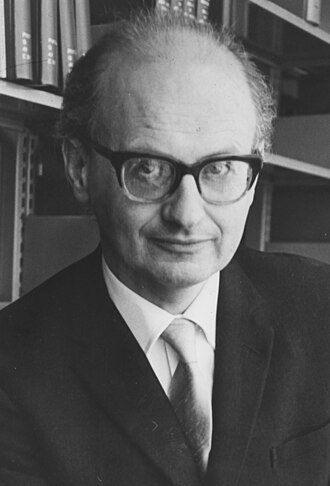
Imre Lakatos was a Hungarian-British philosopher of science and mathematics, a professor at the London School of Economics and one of the central figures in the debate on scientific rationality during the 1960s and 1970s. His work seeks an intermediate position between Popper’s falsificationism and Kuhn’s historical account: against the idea that a single refutation overturns a theory, but also against the idea that scientific change is mere irrational “conversion”. Lakatos proposed that the unit of scientific appraisal is not the isolated theory but the research programme, judged over time by its capacity to anticipate novel facts. He was also an original philosopher of mathematics, showing in Proofs and Refutations that mathematical knowledge grows through a dynamic process of conjectures, proofs, and counterexamples rather than by pure, finished deduction.
Key Concepts
- Scientific research programme (The Methodology of Scientific Research Programmes, papers from the 1960s–70s, collected posthumously in 1978): the unit of analysis is not the isolated theory but a sequence of theories linked by a common plan of development.
- Hard core: the set of fundamental hypotheses of a programme, shielded from refutation by a methodological decision of the scientists.
- Protective belt: the auxiliary hypotheses surrounding the core, which are adjusted or replaced in the face of anomalies in order to preserve the core.
- Positive and negative heuristic: the negative heuristic forbids directing refutation against the core; the positive heuristic guides how to develop and expand the programme.
- Progressive and degenerating programmes (sophisticated falsificationism): a programme is progressive when it anticipates novel facts later corroborated, and degenerating when it merely makes ad hoc adjustments to accommodate anomalies — a dynamic criterion of demarcation, assessed over time.
- Growth of mathematical knowledge (Proofs and Refutations, 1976, posthumous): mathematics advances through conjectures, proofs, and refutations — analysed through Euler’s theorem for polyhedra — against formalism and deductivism.
Influenced by
- Karl Popper — falsificationism, the basis that Lakatos revises and refines.
- Thomas Kuhn — attention to the actual history of science and to the structures that persist through anomalies.
- G. W. F. Hegel — the dialectical conception of the development of knowledge.
- George Pólya — heuristics and the study of mathematical reasoning.
Influenced
- Contemporary philosophy of science and the debates on rationality and demarcation.
- The methodology of theory appraisal in both natural and social sciences.
- Paul Feyerabend — interlocutor and adversary (they planned a joint book, For and Against Method).
- Post-formalist philosophy of mathematics, attentive to actual mathematical practice.
Works
His contribution to the philosophy of mathematics appears in Proofs and Refutations (1976, posthumous), originally published as a series of papers. In the philosophy of science, his essays on the methodology of research programmes were collected posthumously in The Methodology of Scientific Research Programmes (1978). With Alan Musgrave he edited the volume Criticism and the Growth of Knowledge (1970), which gathers the proceedings of the 1965 colloquium with Popper and Kuhn.
See also
Karl Popper, Thomas Kuhn, Paul Feyerabend