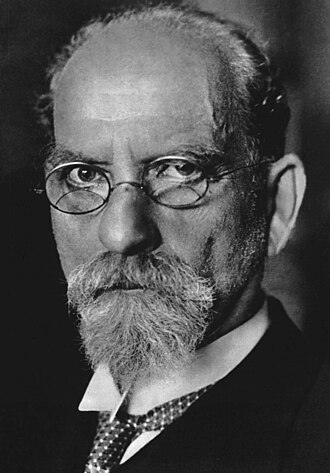
Born in 1859 in Prossnitz, in Moravia (then part of the Austrian Empire), Edmund Husserl trained as a mathematician before turning to philosophy under the influence of Franz Brentano, from whom he inherited the notion of intentionality. Dissatisfied with the psychologism that reduced logic to laws of the mind, he set out to refound philosophy as a rigorous science, capable of describing experience exactly. He was a professor at Göttingen and Freiburg, where he had Heidegger as his assistant and successor. A Jew, he was stripped of his rights by Nazism and died isolated in 1938; his thousands of manuscripts survived only because a Franciscan monk smuggled them into Belgium.
The watchword of phenomenology is “to the things themselves”: to describe phenomena as they are given to consciousness, without presuppositions. Its fundamental concept is intentionality — all consciousness is always “consciousness of something”; it is not a closed box but a relation, an openness to the world.
To gain access to the way things appear, Husserl proposes the phenomenological reduction, or epoché: to “put in brackets” the naive belief in the existence of the world, suspending judgment, in order to describe the lived experience purely. Through the eidetic reduction, one imaginatively varies an object until grasping its invariant essence (eidos). At the end of his life, in The Crisis of the European Sciences, Husserl turns to the lifeworld (Lebenswelt) — the concrete, pre-scientific world that modern science had forgotten. His influence was decisive for Heidegger, Sartre, Merleau Ponty, and Derrida, making phenomenology one of the great currents of the twentieth century.
Key Concepts
- Intentionality: all consciousness is consciousness of something — consciousness does not exist closed in on itself, but always directs itself toward an object
- Phenomenological reduction (epoché): “putting in brackets” the real existence of the world in order to study how it appears to consciousness
- Eidetic reduction: after the epoché, imaginatively vary the object to find its invariant essence (eidos)
- Noesis/Noema: intentional act (the way consciousness aims) / aimed object
- Lifeworld (Lebenswelt): the pre-scientific lived world that modern science has forgotten
Influenced by
- Descartes — return to the ego; method of doubt
- Brentano — intentionality
- Kant — transcendental subject
Influenced
- Heidegger — student who radically transformed phenomenology
- Sartre — existential phenomenology
- Merleau Ponty — phenomenology of perception and the body
- Derrida — deconstruction of phenomenology
- Humanistic psychology (Rogers, Maslow)
Works
Logical Investigations (1900–01); Ideas for a Pure Phenomenology (1913); Cartesian Meditations (1931); The Crisis of European Sciences (1936).
See also
Twentieth-Century Philosophy