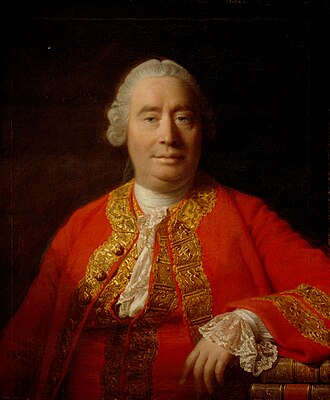
A central figure of the Scottish Enlightenment, David Hume was born in Edinburgh in 1711. While still very young he published his Treatise of Human Nature (1739–40), a work that, in his own words, “fell dead-born from the press” and would be recognized only much later. His reputation as a skeptic in matters of religion cost him the university chairs he sought; he made his living as a librarian, a diplomatic secretary, and above all as a highly successful essayist and historian. A man of serene and amiable temperament — “le bon David” — he died in 1776, facing death with the tranquility of a sage.
Hume takes the empiricism of Locke and Berkeley to its ultimate consequences. The entire content of the mind, he says, reduces to impressions (the vivid perceptions of the senses and emotions) and ideas (their weakened copies). The rule is implacable: no idea is legitimate unless it can be traced back to a corresponding impression — and this suffices to dissolve many concepts dear to metaphysics. Applying it to causality, Hume shows that we never perceive a necessary connection between cause and effect, only a constant conjunction: the notion of cause is a habit of the mind, not a law of nature.
From this arises the famous problem of induction: past regularity does not logically guarantee future regularity, so that not even science rests on an absolute foundation. The self, likewise, is not a permanent substance but a “bundle of perceptions” in flux. In ethics, Hume holds that moral judgments arise from sentiment, not reason — “reason is, and ought only to be, the slave of the passions” — and he formulates the so-called Hume’s guillotine: from propositions about what is, one cannot deduce what ought to be. His skepticism “awakened Kant from his dogmatic slumber” and shaped the utilitarianism of Bentham and J. S. Mill and, in the twentieth century, logical positivism.
Key Concepts
- Impressions and ideas: everything in the mind are impressions (vivid) or ideas (weakened copies). Every idea must have a corresponding impression — ideas without impression are empty words
- Critique of causality: we do not perceive necessary connection — only constant conjunction. Causality is a habit of the mind, not a necessary law of nature
- The self as a bundle of perceptions: there is no permanent substantial self — only a sequence of perceptions
- Hume’s guillotine (is-ought gap): one cannot derive an “ought” from an “is” — naturalistic fallacy
- Sentiment-based ethics: moral judgments express sentiments of approval/disapproval; reason is “slave of the passions”
- Problem of induction: past regularity does not guarantee future regularity — science has no absolute logical foundation
Influenced by
- Locke and Berkeley — British empiricism
- Newton — scientific model but also its limits
Influenced
- Kant — “awakened from dogmatic slumber”
- Bentham — sentiments of pleasure/pain as basis of morality
- Mill — empiricism and induction
- Analytic philosophy (Russell, Ayer — logical positivism)
Works
A Treatise of Human Nature (1739–40); An Enquiry Concerning Human Understanding (1748); An Enquiry Concerning the Principles of Morals (1751); Dialogues Concerning Natural Religion (1779).
See also
Rationalism and Empiricism