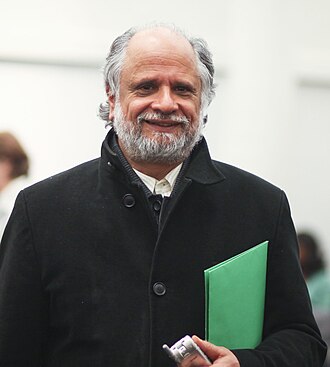
Homi Kharshedji Bhabha (b. 1949, Bombay — now Mumbai) is an Indian theorist of culture and literature, raised within the Parsi community of his native city and educated in Bombay and at Oxford. He holds the Anne F. Rothenberg Professorship of English and American Literature at Harvard and is, alongside Edward Said and Gayatri Spivak, one of the figures who consolidated postcolonial theory as an academic field. His landmark work, The Location of Culture (1994), collects essays that shifted the focus of colonial critique: from the denunciation of domination to the analysis of the ambivalence that runs through every relation between colonizer and colonized. Writing at the crossroads of Derridean deconstruction, the psychoanalysis of Lacan and Freud, and Fanon’s colonial clinic, Bhabha seeks to show that colonial power is never as coherent or as secure as it imagines itself to be.
Key Concepts
- Hybridity: no culture — colonizing or colonized — remains pure. Colonial contact produces mixed, unstable forms, irreducible to any origin. Hybridity is not mere folkloric blending but the process by which colonial authority, in translating itself into the colonized’s context, is repeated with a difference and, in that repetition, subverted.
- Mimicry: the colonial strategy of producing a “reformed” colonized subject who imitates the colonizer’s ways yields a paradoxical effect. The imitator turns out “almost the same, but not quite” — and that small difference (which Bhabha condenses in the provocative formula “almost the same but not white”) exposes the artificiality and fragility of an authority that claimed to be universal.
- The third space and the in-between: cultural meaning does not originate in two fixed identities that later meet; it is produced in an interstitial space of enunciation, where meanings are negotiated and transformed, escaping binary oppositions (self/other, center/periphery).
- Ambivalence: the colonial relation is at once one of attraction and repulsion, desire and contempt. The colonial stereotype, far from being a stable belief, must be anxiously repeated — a sign that the “fixity” it asserts is never guaranteed.
- The nation as narration (Nation and Narration, ed. 1990): nations are not natural facts but narrative constructions, perpetually rewritten; Bhabha analyzes the fissures (“DissemiNation”) between the pedagogical time of national discourse and the performative time of the actual people.
Influenced by
- Frantz Fanon — the psychology of the colonial relation (Bhabha wrote the foreword to Black Skin, White Masks)
- Edward Said — Orientalist discourse
- Jacques Derrida — deconstruction, différance, the trace
- Jacques Lacan and Sigmund Freud — desire, the uncanny (Unheimliche), identification
- Mikhail Bakhtin — the hybridization of language
Influenced
- Contemporary postcolonial studies and cultural studies
- Theories of diaspora, migration, and cosmopolitanism
- Debates on identity, multiculturalism, and cultural translation
Works
Nation and Narration (editor, 1990); The Location of Culture (1994) — his central work, gathering decisive essays such as “Of Mimicry and Man” and “Signs Taken for Wonders.” In later essays Bhabha also developed the notion of vernacular cosmopolitanism — a cosmopolitanism that begins from the margins and from minorities, rather than from the metropolitan center.
Criticism
Bhabha’s dense, allusive style is a matter of controversy: in 1998 he was singled out in the ironic “Bad Writing Contest” run by the journal Philosophy and Literature. On a more substantive note, the Marxist critic Aijaz Ahmad accused postcolonial theory — Bhabha included — of privileging discourse and textuality at the expense of the material and economic determinations of imperialism.
See also
Frantz Fanon, Stuart Hall, Édouard Glissant