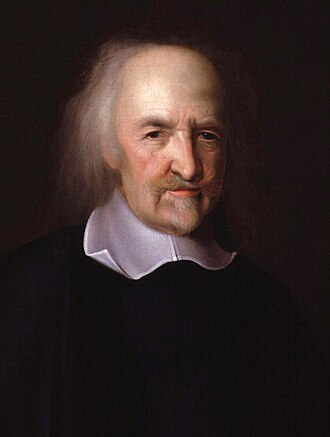
Born in England in 1588 — according to tradition prematurely, amid the panic over the threatened Spanish Armada, which led him to say that “fear and I were born twins” — Thomas Hobbes studied at Oxford and became tutor to the noble Cavendish family. In his travels through Europe, he engaged with the new science of Galileo and with the great philosophers of the continent. A witness to the bloody English Civil War, he went into exile in Paris for over a decade; it was there that he matured the political theory published in Leviathan (1651). He is the founder of modern state theory.
Hobbes sets out from a materialist and mechanist conception: everything, including thought, is matter in motion. His anthropology is dark — the human being is driven by the desire for power and by fear of violent death. He therefore imagines a state of nature without common power: a “war of all against all” (bellum omnium contra omnes), in which life would be “solitary, poor, nasty, brutish, and short,” and man a wolf to man.
The way out of this chaos is rational. Through a social contract, individuals transfer all their rights to a sovereign — the “Leviathan” — in exchange for security and peace. This power must be absolute and indivisible: if divided, war would return. There is, in principle, no right of resistance, except when life itself is threatened — the one good the pact was meant to preserve. Although his absolutist conclusions were contested by Locke and Rousseau, Hobbes fixed the terms — contract, sovereignty, legitimacy — within which modern political thought would henceforth move.
Key Concepts
- State of nature: war of all against all (bellum omnium contra omnes); life “solitary, poor, sordid, brutal and short”; “homo homini lupus”
- Man is moved by the desire for power and by fear of violent death
- Social contract: all cede all their rights to a sovereign in exchange for security
- Absolute and indivisible sovereignty: the Leviathan stands above civil laws; there is no right of resistance
- Materialism: everything is matter in motion — including the soul
- Nominalism: universals are merely names
Influenced by
- Galileo — mathematical and mechanistic method
- Machiavelli — political realism
Influenced
- Locke and Rousseau — diverge from Hobbesian state of nature
- Spinoza — political theory
- Bentham — legislation as social control
- Theory of the modern sovereign State
Works
Leviathan (1651); De Cive (1642); De Corpore (1655).
See also
Contractarianism, Enlightenment and Kant