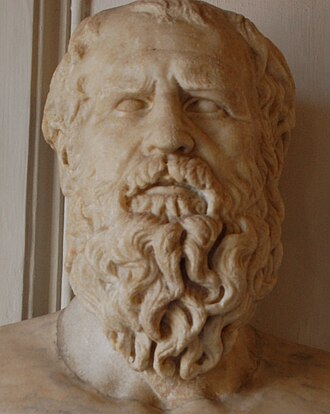
Born in Ephesus, in Ionia, and active around 500 BCE, Heraclitus belonged to an ancient aristocratic family. Proud and solitary in temperament, he wrote in a style of enigmatic aphorisms that earned him, already in antiquity, the epithet “the Obscure.” Some 126 fragments survive — dense, paradoxical, and of extraordinary poetic force.
His central intuition is that of universal becoming: nothing remains, everything transforms ceaselessly — “panta rhei,” “everything flows.” Hence his most famous image: one cannot step into the same river twice, for fresh waters are ever flowing upon those who enter it. As the symbol of this perpetual flux, Heraclitus chose fire as the principle (arché): reality is like a flame that endures precisely because it is always consuming and renewing itself.
But becoming is not chaos. It is ordered by the unity of opposites: day and night, war and peace, life and death are faces of one and the same reality, and the tension between them is what sustains the world — “war is the father of all things.” Governing this entire process is the Logos, the rational law common to all, which most people, however, fail to grasp, living “as though they had a private understanding.” His philosophy of becoming would make Heraclitus the great counterpart to Parmenides and a decisive inspiration for Plato, Hegel, and Nietzsche. Few thinkers have said so much in so few words, and his fragments are still read today as much for their philosophical depth as for their literary power.
Key Concepts
- Arché: fire / becoming
- Panta rhei: everything flows
- Identity and unity of opposites
- Logos as universal rational law
- “One cannot step into the same river twice”
Influenced by
- Anaximander (opposites and the apeiron)
- Orphic tradition (soul of fire)
Influenced
- Plato — dialectic of opposites
- Hegel — dialectic as movement of contraries
- Marx — materialist dialectic
- Nietzsche — becoming against static being
Works
~126 conserved fragments. Ed.: Kirk, Raven & Schofield, The Presocratic Philosophers. Primary sources: Hippolytus, Refutation; Clement of Alexandria.
See also
Presocratica and Sophists