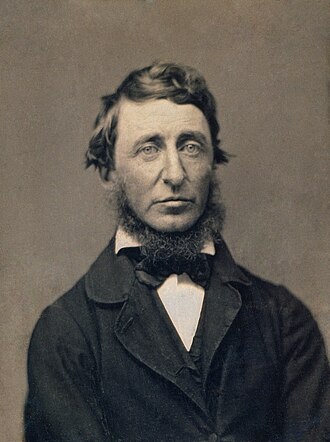
Henry David Thoreau was born in Concord, Massachusetts, on 12 July 1817 and died in the same town on 6 May 1862, of tuberculosis. Baptized David Henry, he began using the reversed order of his name after graduating. He studied at Harvard (1837), taught for a time, and worked with his father in pencil-making and as a surveyor while writing. He was a close friend of Ralph Waldo Emerson, who supported him and in whose Concord circle he was formed. His Journal, kept for decades, is an essential part of his work.
Between 4 July 1845 and 6 September 1847, Thoreau lived in a cabin he built beside Walden Pond, on land owned by Emerson, an experience that gave rise to Walden; or, Life in the Woods (1854). The book combines observation of nature, a critique of the economic and social life of his time, and reflection on simplicity and self-reliance. In July 1846 he spent a night in jail for refusing to pay a poll tax, in protest against slavery and the United States’ war with Mexico. The episode inspired the lecture published in 1849 as “Resistance to Civil Government” and known, since the posthumous 1866 edition, as “Civil Disobedience.”
Key Concepts
- Simple and deliberate living — in Walden, Thoreau criticizes the accumulation of goods and a life subordinated to wage labour, proposing to reduce needs in order to gain freedom and attention to experience. The book presents itself as an experiment in living by principle rather than by habit.
- Resistance of conscience — in “Resistance to Civil Government,” Thoreau holds that the individual has a duty to refuse cooperation with a government that practices injustice, above all slavery, and that individual conscience must take precedence over obedience to the majority. It is an individual, moral refusal rather than a systematic theory of collective disobedience. It is therefore often contrasted with later analyses by philosophers such as John Rawls, who distinguishes civil disobedience, which is public and aimed at changing the law, from individual conscientious refusal.
- Nature and Transcendentalism — Thoreau inherits from Emerson the idea that nature reveals spirit, but his work is marked by close empirical observation of natural phenomena (plants, seasons, the pond), which anticipates concerns of environmental ethics and nature writing.
- Individualism and social critique — an insistence on one’s own judgment and independence from institutions, in line with Emersonian self-reliance but with greater emphasis on everyday practice and anti-slavery engagement (for example in “Slavery in Massachusetts,” 1854, and “A Plea for Captain John Brown,” 1859).
- Walking and attention — in “Walking” (published 1862), Thoreau exalts walking as a form of contact with nature and of cultivating inner freedom.
Influenced by
- Ralph Waldo Emerson — mentor and friend, source of Transcendentalism and of the ideal of self-reliance
- The Greek and Latin classics and Eastern literature, among them the Bhagavad Gita, which Thoreau read and cited
- Thomas Carlyle and English and German Romanticism — the critique of industrial society and the valuing of nature
Influenced
- Mohandas Gandhi — read the essay on civil disobedience and cited it, describing it in 1942 as confirmation of what he was already practising in South Africa; his strategy of resistance thus developed in part independently
- Martin Luther King Jr. — named Thoreau as an influence on his reflection on non-cooperation with evil
- Leo Tolstoy — referred to Thoreau in his correspondence and writings, and is identified by commentators as one of those who spread his ideas in continental Europe
- The environmental movement and the tradition of nature writing in the United States
- Contemporary debates on civil disobedience, conscientious objection and simple living
Works
A Week on the Concord and Merrimack Rivers (1849); “Resistance to Civil Government” (1849; “Civil Disobedience”); Walden; or, Life in the Woods (1854); “Slavery in Massachusetts” (1854); “A Plea for Captain John Brown” (1859); “Walking” (1862); The Maine Woods (1864); Cape Cod (1865).