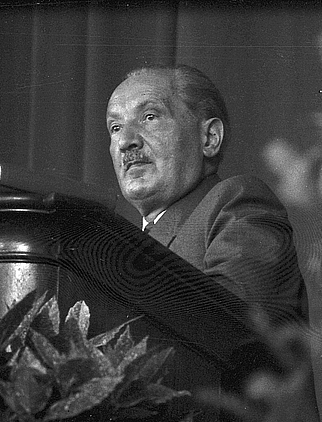
Martin Heidegger was born in Meßkirch, in southern Germany, in 1889, into a modest Catholic family, and came to philosophy by way of theology. Assistant and later successor to Husserl at Freiburg, he published Being and Time in 1927, the work that established him as one of the most influential — and most controversial — philosophers of the twentieth century. The controversy is inseparable from his biography: in 1933 he assumed the rectorate of Freiburg and joined the Nazi party, a commitment he never publicly renounced and which the Black Notebooks, published decades later, revealed to be shot through with antisemitism. The moral and philosophical weight of this engagement remains an open debate.
Heidegger’s project is radical: to reopen the question of Being (Seinsfrage), which he held that Western metaphysics had forgotten ever since Plato, confusing Being with beings (the “ontological difference”). To regain the question, he begins from the one being that questions its own being: the human being, which he renames Dasein (“being-there”). Dasein is not a closed subject facing objects but being-in-the-world — always already thrown into a world of meaning, relations, and care (Sorge).
Authentic existence is born of the confrontation with finitude: as being-toward-death, Dasein can tear itself away from the anonymity of the “they” (das Man), in which we live as “one lives,” and take up its existence as its ownmost task. In his later work, after the so-called Kehre (turn), Heidegger turns toward language (the “house of Being”), toward poetry, and toward a penetrating critique of modern technology, which would reduce everything — including humanity — to mere “standing-reserve” available for exploitation. His influence was immense: on the existentialism of Sartre, the hermeneutics of Gadamer, and the post-structuralism of Foucault and Derrida.
Key Concepts
Being and Time (1927)
- Dasein (being-there): the specifically human mode of being — not a closed subject, but openness to Being
- Being-in-the-world: Dasein is always already in the world — not a subject that subsequently encounters objects
- Care (Sorge): fundamental structure of Dasein; articulates facticity, projection, and falling
- Being-toward-death: death is the most proper, certain, non-transferable possibility → anxiety → authenticity
- Authenticity vs. Inauthenticity: the Man (the “one says,” the impersonal) levels down existence; anxiety calls one forth to one’s ownmost self
- Temporality: past (facticity) + future (projection) + present (falling)
Later Work (after the Kehre)
- Forgetfulness of Being: Western metaphysics since Plato has forgotten the ontological difference (Being vs. beings)
- Modern technology: reduces everything to standing-reserve (Bestand) available for exploitation; man becomes a resource
- “Language is the house of Being” — art and poetry as paths of disclosure
Influenced by
- Husserl (master; surpassed and transformed)
- Aristotle — ousia, time
- Kierkegaard — individual existence, anxiety
- Nietzsche — critique of metaphysics
Influenced
- Sartre — existentialism (via reception of Being and Time)
- Gadamer — philosophical hermeneutics
- Foucault — genealogy of power-knowledge
- Derrida — deconstruction of presence
Works
Being and Time (1927); The Question Concerning Technology (1954); The Origin of the Work of Art (1935–36); Letter on Humanism (1946).
See also
Twentieth-Century Philosophy