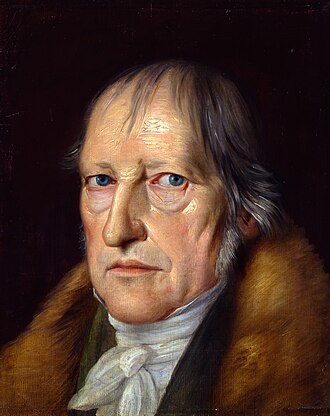
Georg Wilhelm Friedrich Hegel was born in Stuttgart in 1770 and studied at the Tübingen seminary alongside Hölderlin and Schelling. A young enthusiast of the French Revolution, he saw in Napoleon — whom he glimpsed on horseback at Jena in 1806 — the “world-soul” on the march. After years as a private tutor, journalist, and school headmaster, he reached the chairs of Heidelberg and, above all, Berlin, where he became the most influential philosopher in the Germany of his time, until his death in 1831. His work is the most ambitious system in the history of philosophy: logic, nature, spirit, history, art, and religion articulated as moments of a single process.
At the heart of this system lies the dialectic — not a mechanical formula, but the very movement of thought and of the real: every concept carries within it its own negation, and the conflict between them resolves into a higher synthesis that at once cancels and preserves the opposites (Aufhebung). For Hegel, the Absolute is not a static substance but Spirit (Geist) realizing itself in time, gradually coming to consciousness of itself. Hence the famous formula from the preface to the Philosophy of Right: “what is rational is actual, and what is actual is rational.”
The Phenomenology of Spirit (1807) narrates this odyssey of consciousness, from sensuous certainty to absolute knowledge, passing through figures such as the master-slave dialectic, in which recognition and labor found self-consciousness. In history, the World Spirit progressively realizes freedom, finding in the State its highest ethical expression. Acknowledging the retrospective character of philosophy, Hegel wrote that “the owl of Minerva spreads its wings only with the falling of the dusk.” His influence was decisive and forked: it inspired the materialist inversion of Marx, the individualist revolt of Kierkegaard, and, later, Critical Theory and the entire French reception of the twentieth century.
Key Concepts
- Dialectics: not a mechanical formula, but the internal movement of the Idea — each concept contains its own negation; the negation is negated (Aufhebung: to supersede-while-preserving)
- “The Real is Rational; the Rational is Real”
- Phenomenology of Spirit: the journey of consciousness from sensuous certainty to Absolute Knowledge
- Master/Slave Dialectic: the master depends on the recognition of the slave; labor liberates the slave
- Objective Spirit: right → morality → ethical life (family → civil society → State)
- State as the full realization of freedom — not a contract (against Rousseau)
- Absolute Spirit: art → religion → philosophy
- Philosophy of History: each people has a mission; the World Spirit (Weltgeist) realizes itself progressively
- “The Owl of Minerva spreads its wings only with the falling of the dusk” — philosophy comprehends the real only after it has been consummated
Influenced by
- Kant — point of departure; eliminates the thing-in-itself
- Fichte and Schelling — idealism
- Spinoza — “to begin with Spinoza is to begin philosophizing”
- Heraclitus — dialectics of opposites
- Plato — ascending dialectics
Influenced
- Marx — materialist inversion of the dialectic
- Kierkegaard — rejection of the system in favor of the individual
- Engels, Lenin — Marxism
- Frankfurt School — Adorno, Horkheimer
- Kojève and Sartre — via French reception
- Fukuyama — “end of history”
Works
Phenomenology of Spirit (1807); Science of Logic (1812–16); Encyclopedia of the Philosophical Sciences (1817); Philosophy of Right (1820).
See also
German Idealism