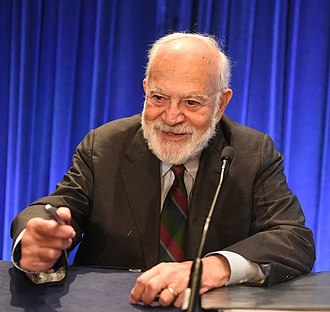
Harry Gordon Frankfurt (29 May 1929, Langhorne, Pennsylvania — 16 July 2023, Santa Monica, California) was an American philosopher, professor emeritus at Princeton University, one of the most influential figures in the philosophy of action and of free will in the twentieth century. He began as a scholar of Descartes (Demons, Dreamers, and Madmen, 1970) and went on to build a concise, incisive body of work on the will, the person, and love — plus a short essay that would belatedly make him a bestselling author.
Key Concepts
- Frankfurt cases (“Alternate Possibilities and Moral Responsibility,” 1969): ingenious counterexamples to the Principle of Alternate Possibilities (PAP), on which we are responsible for an act only if we could have done otherwise. Frankfurt imagines a manipulator ready to intervene should the agent show signs of deciding differently — but who never needs to, because the agent does on his own just what the manipulator wanted. The agent is responsible even though he could not have done otherwise. The argument reoriented the free-will debate in favor of compatibilism.
- The hierarchical theory of the will (“Freedom of the Will and the Concept of a Person,” 1971): it distinguishes first-order desires (wanting to do X) from second-order desires (desires about one’s own desires). A second-order volition is wanting a certain desire to be the will that actually moves one. There is freedom of the will when what moves us coincides with what we want to move us — when we “want to want” what we want.
- The wanton: a being with first-order desires but no second-order volitions — indifferent to which of its impulses prevails. The wanton acts, but is not properly a person, for it takes no stand on its own will. Personhood arises from this reflective capacity to identify with one’s own desires.
- Caring, love, and volitional necessity (The Importance of What We Care About, 1988; The Reasons of Love, 2004): what we care about and whom we love provide the most fundamental practical reasons. There are “necessities of the will” — situations in which we cannot will otherwise and yet are fully free, because our will is wholly in it.
- On Bullshit (essay 1986, book 2005): the bullshitter differs from the liar. The liar knows the truth and cares about it (so as to conceal it); the producer of bullshit is indifferent to whether what he says is true or false. For that reason, Frankfurt argues, bullshit is a greater enemy of truth than the lie.
Influenced by
- Descartes — the object of his early studies of will and reason
- The tradition of the free-will debate (Hobbes, Hume, compatibilism)
- Kant — the notion of autonomy, with which he engages and diverges
Influenced
- Contemporary philosophy of free will and moral responsibility (John Martin Fischer, Gary Watson)
- Theories of personal autonomy and identification
- The philosophy of action and of the agent
- Public debate on truth, lying, and disinformation
Works
Demons, Dreamers, and Madmen (1970); The Importance of What We Care About (1988); Necessity, Volition, and Love (1999); On Bullshit (2005); The Reasons of Love (2004).
See also
Descartes, Kant, Peter Singer