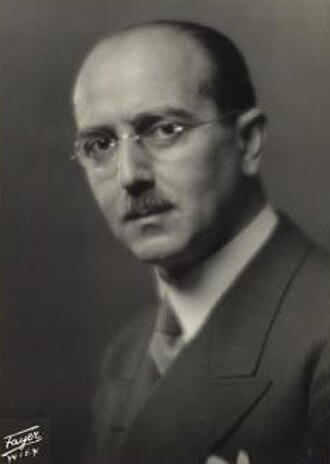
Hans Kelsen was born in Prague on 11 October 1881 and died in Orinda, California, on 19 April 1973. Raised in Vienna, he became professor of public law at the University of Vienna, where he founded the so-called Vienna School of legal positivism. He was the principal drafter of the Austrian Constitution of 1920 and sat on the Austrian Constitutional Court (1920–1930), the model of concentrated constitutional adjudication. Removed from the court in 1930, he taught at Cologne until dismissed by the Nazi regime in 1933; he passed through Geneva and Prague and emigrated to the United States in 1940, where he was a professor at Berkeley (from 1945).
His project is the construction of a “pure” science of law, that is, one purified of elements of psychology, sociology, politics, and morality, so as to take positive legal norms as its sole object. The neo-Kantian influence appears in the distinction between being (Sein) and ought (Sollen): law belongs to the realm of the ought and cannot be deduced from facts.
Key Concepts
- Pure Theory of Law — formulated in Reine Rechtslehre (1934; 2nd ed., substantially revised, 1960), it proposes a general theory of positive law, descriptive and free of value judgments; legal science describes norms rather than justifying them morally.
- Basic norm (Grundnorm) — a logical-transcendental presupposition grounding the validity of the entire legal order: it is not a posited norm but the condition for thinking the historical constitution as binding. In later works, Kelsen calls it a fiction, in the sense of the “as if.”
- Hierarchical structure (Stufenbau) — the legal order is a hierarchy in which each norm derives its validity from a higher one, up to the constitution and ultimately the basic norm; a formulation developed in dialogue with Adolf Merkl.
- Validity and efficacy — a norm’s validity does not depend on its efficacy in each case, but a legal order as a whole must be generally efficacious to be considered valid.
- Identity of state and law — the state is not an entity prior to law; it is the legal order itself personified.
- Constitutional adjudication — the constitution requires a guardian in the form of a specialized court, an idea realized in the Austrian model.
- Democracy and relativism — in Vom Wesen und Wert der Demokratie (1920) and Foundations of Democracy (1955), he ties democracy to the absence of absolute political truths and to compromise among positions.
The Debate with Schmitt
In The Guardian of the Constitution (1931), Carl Schmitt argued that the natural guardian of the Weimar Constitution was the Reich President, since constitutional adjudication would turn the court into a political body. Kelsen replied the same year in Who Ought to Be the Guardian of the Constitution?, holding that constitutional adjudication is a legal function and that assigning guardianship to the head of state would compromise the review of constitutionality itself. The debate remains a reference on the limits of judicial power and the role of the sovereign.
Criticism
H.L.A. Hart, in The Concept of Law (1961), contrasted the presupposed basic norm with a rule of recognition of a social, empirical nature. Joseph Raz discussed the coherence of the concept. Natural law theorists and Ronald Dworkin criticize the separation of law and morality, and the idea that the basic norm is a mere fiction has been seen by some as weakening the theory. The reach of methodological purity and the difficulty of accommodating legal principles are also debated.
Influenced by
- Kant and neo-Kantianism — the distinction between being and ought and the transcendental conditions of knowledge
- Adolf Merkl — the hierarchical structure of the legal order
- Georg Jellinek and Paul Laband — German public-law scholarship, an object of criticism and reworking
Influenced
- H.L.A. Hart — in critical dialogue, in the formulation of secondary rules and the rule of recognition
- Norberto Bobbio and Joseph Raz
- Eric Voegelin, who was his student and from whom he diverged
- The design of European and Latin American constitutional courts
Works
Hauptprobleme der Staatsrechtslehre (1911); Vom Wesen und Wert der Demokratie (1920); Allgemeine Staatslehre (1925); Wer soll der Hüter der Verfassung sein? (1931); Reine Rechtslehre (1934; 2nd ed. 1960); General Theory of Law and State (1945); Was ist Gerechtigkeit? (1953; English What Is Justice?, 1957); Allgemeine Theorie der Normen (posthumous, 1979).
See also
Carl Schmitt, H.L.A. Hart, Ronald Dworkin, Kant, Eric Voegelin, John Rawls