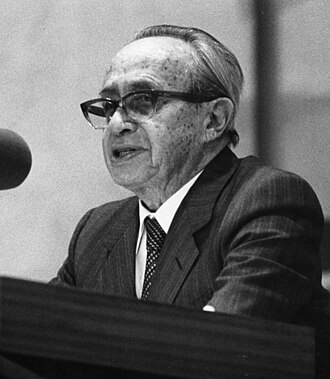
Hans Jonas was born in Mönchengladbach, Germany, on 10 May 1903 and died in New Rochelle, New York, on 5 February 1993. He studied philosophy, theology, and art history at Freiburg, Berlin, and Marburg, where he was a student of Martin Heidegger and Rudolf Bultmann and earned his doctorate in 1928 with a dissertation on the concept of Gnosis. In Marburg he began a lifelong friendship with Hannah Arendt. A Jew, he left Germany in 1933 after the Nazi rise to power, spent time in England, and settled in Palestine in 1934; during the Second World War he served in the Jewish Brigade of the British army, and his mother was murdered at Auschwitz. After the war he taught in Israel and Canada and, from 1955, at the New School for Social Research in New York, where he remained until his retirement in 1976.
His work unfolds in three major phases. The first is historical and religious: Gnosis und spätantiker Geist (1934, 1954) and The Gnostic Religion (1958) interpret ancient Gnosticism through existential categories, and Jonas saw in it a parallel, though a contested one, with modern nihilism. The second is the philosophy of biology, developed in The Phenomenon of Life (1966) and Organismus und Freiheit (1973): Jonas argues that metabolism, in which an organism preserves its identity while exchanging matter with its environment, already displays an elementary form of freedom and inwardness. He criticizes Cartesian dualism and reductive materialism, which in his view share the same mechanistic presupposition. The third is ethics, whose landmark is Das Prinzip Verantwortung (1979; English The Imperative of Responsibility, 1984).
In that book Jonas argues that modern technology has so enlarged the reach and irreversibility of human action that traditional ethics, centered on relations between neighbors and on the immediate present, has become inadequate. He proposes a new imperative, formulated in contrast to Kant’s categorical imperative: act so that the effects of your action are compatible with the permanence of genuine human life on Earth. In 1987 he received the Peace Prize of the German Book Trade.
Key Concepts
- Principle of Responsibility — a future-oriented ethics that grounds the duty to preserve the conditions for the existence of humanity and of non-human nature in the face of technological power.
- Heuristics of fear — a method holding that, where consequences may be irreversible, the negative forecast takes precedence over the positive one; uncertainty justifies caution.
- Imperative of responsibility — a reformulation of the Kantian imperative for an agency whose consequences bear on the continuity of human life.
- Metabolism and organic freedom — the thesis that organic life manifests a primitive freedom, the basis of a “philosophical biology” that reintegrates mind into nature.
- Gnosis and nihilism — a reading of ancient Gnosticism as an existential key to the dualism and alienation of modern man.
- Ontological responsibility — the grounding of duty in the claim that being, and life in particular, has intrinsic value.
- The concept of God after Auschwitz — an essay (published in English in 1987) in which Jonas proposes a God who withdraws and ceases to be omnipotent so that the world may exist.
Influenced by
- Martin Heidegger — existential phenomenology, method of analysis of Gnosticism
- Rudolf Bultmann — New Testament theology and hermeneutics
- Edmund Husserl — phenomenology, the starting point of his training
- Immanuel Kant — the form of the imperative, which Jonas reworks and criticizes
- Jewish tradition — the basis of his theological reflections
Influenced
- Contemporary environmental ethics and the ethics of technology
- Bioethics, in debates on genetic intervention and responsibility toward future generations
- The debate on the precautionary principle in environmental policy
- Phenomenologically inspired philosophy of biology
Works
Gnosis und spätantiker Geist (1934, 1954); The Gnostic Religion (1958); The Phenomenon of Life (1966); Organismus und Freiheit (1973); Das Prinzip Verantwortung (1979); Technik, Medizin und Ethik (1985); Der Gottesbegriff nach Auschwitz (lecture 1984, published 1987).
See also
Martin Heidegger, Hannah Arendt, Immanuel Kant, Philosophy of Technology, Environmental Ethics