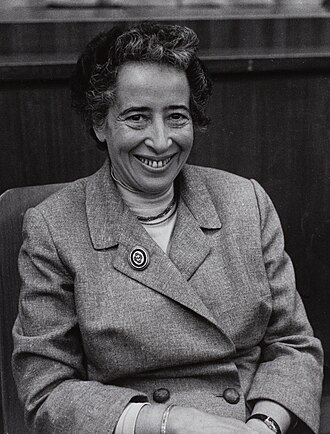
German-American political philosopher, Jewish, student of Heidegger and Jaspers. Thinker of totalitarianism, political freedom, and human action. One of the most original voices of the 20th century.
Trained in the German phenomenological and existential tradition, Arendt wrote her doctoral dissertation on the concept of love in Saint Augustine, under the supervision of Jaspers. The rise of Nazism violently interrupted her path: as a Jew, she was forced to flee Germany in 1933 and, after years as a stateless person in France, emigrated to the United States, where she became a naturalized American citizen. The experience of uprooting, persecution, and the loss of a common world became the lived ground from which her work asks what it means, in the century of concentration camps and mass refugeehood, to preserve a place for human dignity and plurality.
Rather than building a system, Arendt practices a thinking that always sets out from concrete experience in order to recover the meaning of worn-out political concepts — power, authority, freedom, action, judgment. She refused the label of “philosopher,” preferring to present herself as a political theorist, and distrusted the tradition that, from Plato onward, subordinated the active life to contemplation and treated plurality as a problem to be mastered. Her method of “understanding,” as she called it, seeks to reconcile itself with reality without either rationalizing it or fleeing from it. This effort earned her lasting controversies — above all over the “banality of evil” — but also secured her growing influence on democratic theory, the study of violence and revolution, and the contemporary debate on citizenship and human rights.
Key Concepts
- The Origins of Totalitarianism (1951): totalitarianism (Nazism and Stalinism) is a radically new phenomenon — not classical tyranny; it is based on total terror, ideology, and the destruction of public space and human singularity
- The Human Condition (vita activa, 1958): three fundamental activities:
- Labor: metabolism with nature, production of the necessary (animal laborans)
- Work: fabrication of durable objects, artificial world (homo faber)
- Action: the initiation of the genuinely new among humans — the only directly political activity; reveals who one is (not what)
- Banality of Evil (Eichmann in Jerusalem, 1963): Adolf Eichmann was not a monster, but a bureaucrat without thought; this banal evil does not require perversity — mere absence of reflection (thoughtlessness) suffices
- Public space: politics as a space of appearance among equals, where words and actions reveal identity — against the privatization of political life
- Natality (counterpart to Heideggerian mortality): each human being is a new beginning — the capacity to initiate something radically new is the basis of political freedom
Influenced by
- Heidegger — fundamental ontology, analysis of existence (but criticizes his Nazi engagement)
- Karl Jaspers — existentialism and communication
- Aristotle — vita activa, politics as the highest mode of life
- Kant — judgment, sensus communis, political philosophy
Influenced
- Contemporary political philosophy
- Studies on totalitarianism and democracy
- Theory of moral judgment
- Judith Butler — precariousness and political life
Works
The Origins of Totalitarianism (1951); The Human Condition (1958); Between Past and Future (1961); Eichmann in Jerusalem (1963); On Revolution (1963); The Life of the Mind (posthumous, 1978).
See also
Twentieth Century Philosophy