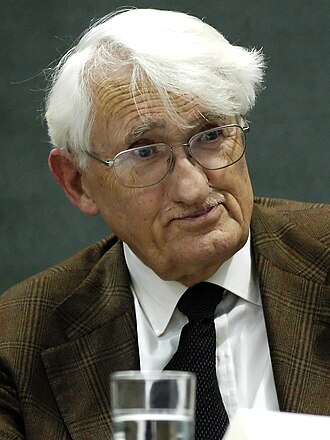
Born in 1929 in Germany, and marked in his youth by the experience of Nazism and the postwar period, Jürgen Habermas became the leading name of the second generation of the Frankfurt School and one of the most influential philosophers of recent decades (he died in 2026). An assistant to Adorno, he inherited the tradition of Critical Theory but rejected its pessimism: where Horkheimer and Adorno saw modern reason degenerate into sheer domination, Habermas sought to recover an emancipatory potential within reason itself.
His key is the linguistic turn. He distinguishes instrumental reason — which calculates means to ends and treats the other as an object to manipulate — from communicative reason, which is realized in dialogue oriented toward mutual understanding. In “communicative action,” participants seek agreement on the basis of arguments, recognizing one another as equals. As a normative horizon, Habermas formulates the idea of an ideal speech situation: communication free of coercion, in which only the force of the better argument counts — the foundation of his theory of democracy.
Hence his diagnosis of modernity: the lifeworld (Lebenswelt) — the sphere of culture, socialization, and meaning — is being “colonized” by the impersonal systems of the market and state bureaucracy. The way out is not to abandon modernity but to complete its unfinished project, revitalizing the public sphere and democratic deliberation. With works such as the Theory of Communicative Action, Habermas profoundly influenced contemporary political philosophy, constitutional law, and social theory.
Key Concepts
- Communicative action (Theory of Communicative Action, 1981): distinguishes strategic action (oriented toward success, instrumentalizes the other) from communicative action (oriented toward mutual understanding, recognizes the other as a subject)
- Ideal speech situation: counterfactual presupposition of communication — all participants have equal access, without coercion; normative foundation of deliberative democracy
- Lifeworld (Lebenswelt) vs. systems: the lifeworld (culture, society, personality) is colonized by the functional systems of the market and bureaucratic state — the “pathology” of modernity
- Public sphere (The Structural Transformation of the Public Sphere, 1962): space of rational-critical debate among citizens; thesis of degeneration under mass capitalism
- Discourse ethics (with Karl-Otto Apel): moral norms are valid when all affected parties could consent to them in an ideal practical discourse
Influenced by
- Horkheimer and Adorno — Critical Theory (but critical of their pessimism)
- Marx — emancipation and alienation (reformulated)
- Kant — ethical universalism and practical reason
- Hegel — intersubjectivity and recognition
- Ludwig Wittgenstein and J.L. Austin — philosophy of language and speech acts
Influenced
- Deliberative political philosophy (discursive democracy)
- Law and constitutional theory (Between Facts and Norms)
- Theory of the social sciences
Works
The Structural Transformation of the Public Sphere (1962); Knowledge and Human Interests (1968); Theory of Communicative Action (1981); The Philosophical Discourse of Modernity (1985); Between Facts and Norms (1992).
See also
20th Century Philosophy