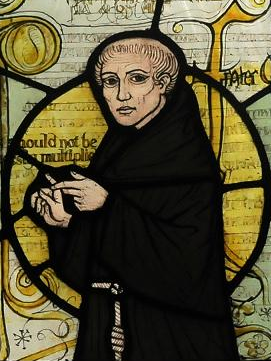
Born around 1287 in the English village of Ockham, in Surrey, William entered the Franciscan order and studied at Oxford. Accused of heresy, he was summoned to the papal court at Avignon; caught up in the dispute between the Franciscans and Pope John XXII over evangelical poverty, he ended up fleeing to the court of Emperor Louis of Bavaria, under whose protection he lived until his death, around 1347. His work marks the end of classical Scholasticism and opens the way to Modernity.
Ockham is the “prince of the nominalists.” Against medieval realism, he holds that universals (such as “humanity,” “whiteness”) have no existence outside the mind: they are merely signs, names we use to group individuals. In reality, only singular, concrete things exist. From this follows his famous principle of economy — “Ockham’s razor”: entities should not be multiplied beyond necessity, that is, between two explanations one should prefer the simpler. This principle of parsimony became a pillar of the modern scientific method.
Ockham also led to a radical separation between faith and reason: revealed truths cannot be demonstrated by philosophy, so that theology and natural reason have distinct domains. This “via moderna” influenced the formation of Luther and the thought of the Reformation; his political theses, which defended limits to papal power, anticipated debates about the autonomy of secular power. In dismantling the realist metaphysical edifice, Ockham prepared the ground for the empiricism and the science that would come.
Key Concepts
- Occam’s Razor: “Do not multiply entities without necessity” — the principle of parsimony; eliminate superfluous metaphysical entities
- Nominalism: universals are merely logical terms (termini), not external realities; only concrete individuals exist
- Knowledge is always of singulars (intuitive: of the present thing; abstractive: of the absent thing)
- Autonomy of faith and reason: the truths of faith are not demonstrable by reason — radical separation
- Political theory: the Church as a free community of believers; not absolute papal government → anticipates the Reformation
- Occam’s razor is the basis of modern scientific method
Influenced by
- Duns Scotus (master; radicalized some positions)
- Aristotle — logic and physics
Influenced
- Protestant Reformation (Luther studied Ockham in the via moderna)
- Francis Bacon — idols as analogous obstacles
- Analytic philosophy — principle of parsimony
Works
Summa of Logic (Summa Logicae); Questions on the Sentences; political writings (Breviloquium, Dialogue).
See also
Medieval Philosophy