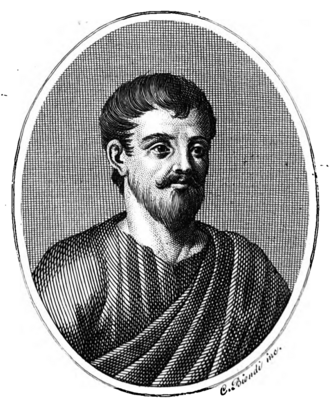
A native of Leontini, in Sicily, Gorgias lived, according to tradition, more than a hundred years (c. 483–375 BCE). He came to Athens in 427 BCE as ambassador of his city and dazzled the Athenians with a new oratorical style, full of figures and rhythms — becoming the most celebrated and highly paid master of rhetoric of Antiquity. Alongside Protagoras, he is the great figure of the first generation of the Sophists.
His philosophical side appears in the provocative treatise On Non-Being, in which he defends, through a chain of arguments, three radical theses: first, that nothing exists; second, that even if something existed, we could not know it; and third, that even if we could know it, we could not communicate it to others. It is in part a parody of the metaphysics of Parmenides and the Eleatics, pushing the power of argument to its extreme.
The lesson Gorgias draws from this is not despair but the sovereignty of the word. If language does not mirror reality, then it does not represent: it produces effects, persuades, moves. In the Encomium of Helen, he describes the logos (speech) as “a powerful lord” capable of anything — of healing or poisoning the soul like a drug. Rhetoric thus becomes the supreme art, able to convince multitudes even without technical knowledge. Plato, who devoted an entire dialogue to him, would combat this conception in the name of philosophy and truth. To this day his work is studied as a landmark of rhetoric and of the philosophy of language, and Gorgias is remembered as one of the first thinkers to make explicit the power of discourse — its capacity both to reveal and to manipulate, to persuade multitudes at the margin of truth.
Key Concepts
- Radical skepticism (3 theses on non-being)
- Rhetoric as autonomous power
- Language as creation, not representation
Influenced by
- Parmenides — reductio of being to non-being
- Zeno of Elea — argumentation by reduction to absurdity
Influenced
- Plato — dialogue Gorgias (critique of rhetoric)
- Ancient skepticism (Pyrrho)
- Modern philosophy of language; contemporary rhetoric
Works
On Non-Being (summarized by Sextus Empiricus); Encomium of Helen; Defense of Palamedes. Source: Plato, Gorgias.
See also
Pre-Socratics and Sophists