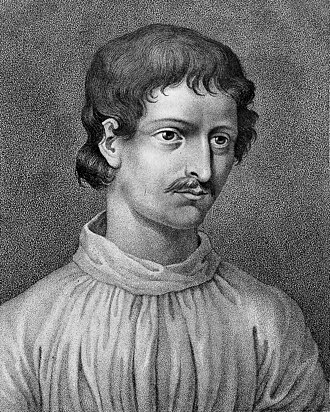
Born in Nola, near Naples, in 1548, Giordano Bruno was a Dominican friar, but, accused of heresy, he abandoned the habit while still young and began a wandering life that took him through Geneva, Paris, London, Germany, and Prague, teaching cosmology, the art of memory, and his own daring ideas. Back in Italy, he was arrested by the Inquisition, held in prison for eight years and, refusing to recant, burned alive in Rome, in the Campo de’ Fiori, on 17 February 1600. He has since become a symbol of freedom of thought in the face of dogma.
His cosmology was revolutionary. Taking the heliocentrism of Copernicus to its ultimate consequences, Bruno abolished the boundaries of the cosmos: the universe is infinite, without center or limits, populated by infinite worlds similar to our own, and the Sun is but one star among countless others. It was a dizzying vision, centuries ahead of the science of his time.
To this infinite physics corresponds a pantheist metaphysics: God is not an external creator but the infinite One that manifests and lives in all things — nature itself is divine. Heir to Nicholas of Cusa, to Renaissance Hermeticism, and to the neoplatonism of Plotinus, Bruno fused science, magic, and religion in a singular synthesis. It should be noted that his condemnation involved above all theological heresies, and not cosmology alone; even so, his death made him an enduring emblem, and his intuitions would echo in Spinoza (Deus sive Natura) and in Romanticism.
Key Concepts
- Infinite universe: infinite inhabited worlds; Earth is not the center; the Sun is a star among infinities
- Pantheism: God = infinite One that manifests in all things; nature is God implicated
- Hierarchy: God (One above things) → Universal Intellect (divine force in things) → Matter (one-multiple universe)
- Heroic fury: love of knowledge of the infinite — deification, union of man with the whole
- Death = accidental mutation; there are infinite individuals living in us
Influenced by
- Nicholas of Cusa — coincidence of opposites, infinite universe
- Copernicus — heliocentrism
- Marsilio Ficino — natural magic, the One
- Plotinus — emanation
Influenced
- Spinoza — Deus sive Natura
- Schelling — philosophy of nature
- German Romanticism
- Modern scientific thought (infinite universe)
Works
On the Infinite, the Universe and the Worlds (1584); On Cause, Principle and Unity (1584); De gli Eroici Furori (1585).
See also
Humanism and Renaissance