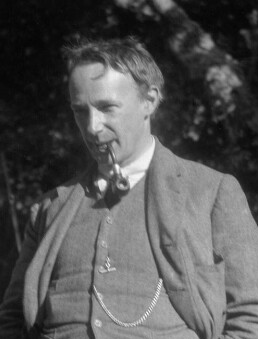
British philosopher, co-founder — alongside Russell and Frege — of analytic philosophy. His critique of British idealism and his work in ethics decisively influenced the entire analytic tradition of the 20th century.
Key Concepts
- Naturalistic fallacy: the error of defining the good in terms of natural properties (pleasure, evolution, desire). The good is simple, indefinable, and non-natural — it cannot be reduced to any empirical property. A central critique of utilitarianism and ethical naturalism
- Open question argument: for any natural property X, it always makes sense to ask “Is X good?” — if the good were identical to X, the question would be absurd. This proves that good ≠ X
- Moral intuitionism: fundamental moral values are known by direct intuition, not by inference or definition. Ethics is an autonomous science, not reducible to natural sciences
- Common sense realism: against the idealism of Berkeley and Hegel — the external world exists independently of the mind. Defense of common sense realism as the philosophical starting point
- Proof of the external world: “here is a hand, here is another” — he argues that we can prove the existence of the external world with more certainty than any abstract philosophical premise that denies it
- Conceptual analysis: the central task of philosophy is analysis — decomposing complex concepts into their simpler, more precise components; the program that defines analytic philosophy
- Intrinsic goods: certain states are good in themselves (friendship, beauty, knowledge) — independently of any consequence. A critique of hedonistic utilitarianism
Influenced by
- Kant — deontological ethics and moral autonomy
- Russell — analytic program (mutual influence)
- Sidgwick — British moral intuitionism
Influenced
- Russell and Wittgenstein — analytic philosophy
- Bloomsbury Group (Virginia Woolf, Keynes) — ethics and aesthetics
- Contemporary metaethics (intuitionism, moral realism)
- Karl Popper — theory of knowledge
Works
Principia Ethica (1903); Ethics (1912); Philosophical Studies (1922); Some Main Problems of Philosophy (1953).
See also
Twentieth-Century Philosophy
Recommended Books:
 Select Philosophical Writings: Principia Ethica, Ethics, Philosophical Studies, Other Essays
Ver na Amazon →
Select Philosophical Writings: Principia Ethica, Ethics, Philosophical Studies, Other Essays
Ver na Amazon →
 Principia Ethica
Ver na Amazon →
Principia Ethica
Ver na Amazon →