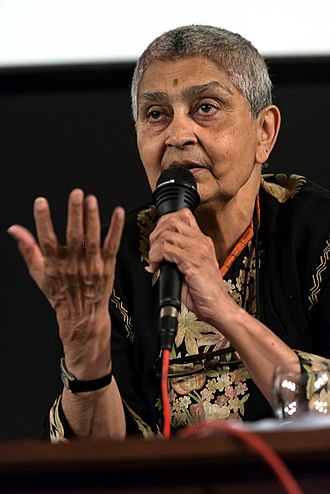
Gayatri Chakravorty Spivak (b. 1942, Calcutta) is an Indian theorist and professor of comparative literature at Columbia University. Her English translation of De la grammatologie (1976) made Derrida available to the Anglophone world and marked the beginning of one of the most influential — and resolutely non-synthetic — bodies of work in contemporary theory. Spivak combines deconstruction, Marxism, feminism, and postcolonial critique. She was associated with the Subaltern Studies Group, a collective of South Asian historians who, drawing on Gramsci and Ranajit Guha, proposed to rewrite colonial and national history from the standpoint of the subaltern classes. Her essay “Can the Subaltern Speak?” (1988) became a canonical reference of the field. In later works, Spivak extended her reflection to globalisation, pedagogy, and world literature.
Key Concepts
- Subaltern (drawing on Gramsci and the Subaltern Studies Group; “Can the Subaltern Speak?”, 1988): a figure whose voice and testimony are structurally erased from the archives of hegemonic history; not “anyone dominated”, but the one whose intelligibility is blocked by the very codes of colonial and national representation.
- The question “can the subaltern speak?” (“Can the Subaltern Speak?”, 1988): exemplified by her analysis of sati (widow self-immolation) in colonial India — the subaltern woman is caught between two competing representations (British colonial discourse and Indian patriarchal discourse), and neither lets her speak; the provocative “no” of Spivak’s answer is less an ontological denial than a diagnosis of the conditions of listening.
- Epistemic violence (“Can the Subaltern Speak?”, 1988): the gesture by which colonial knowledge constitutes its object by destroying the modes through which that object understood itself.
- Strategic essentialism (1980s interviews): the provisional, politically situated use of identity categories, with full critical awareness of their constructedness; Spivak later distanced herself from the term once it had been popularised.
- Translation as ethical task (The Politics of Translation, 1992; Death of a Discipline, 2003): literary translation is not a neutral vehicle but an exercise of rigorous hospitality between languages and literatures, capable of decolonising the comparatist canon.
- Aesthetic education in globalisation (An Aesthetic Education in the Era of Globalization, 2012): a critical retrieval of Schiller to argue that aesthetic education is a condition for the formation of citizens able to resist the financial abstraction of the world.
Influenced by
- Derrida — deconstruction, trace, and différance
- Marx — critique of political economy
- Foucault — discourse analysis (in critical dialogue)
- Ranajit Guha — subalternist historiography
- Mahasweta Devi — Bengali fiction, which Spivak translated
Influenced
- Edward Said — reciprocal dialogue in postcolonial studies
- Judith Butler — performativity and feminist critique
- Homi Bhabha — third space and colonial critique
- Achille Mbembe — decolonial thought
- Latin American subaltern studies
Works
Her translation of Derrida, Of Grammatology (1976), with a long critical introduction, is itself a landmark. The essay “Can the Subaltern Speak?” was published in 1988 (in Marxism and the Interpretation of Culture). In Other Worlds (1987) collects essays on literature and politics. A Critique of Postcolonial Reason: Toward a History of the Vanishing Present (1999) is her most ambitious theoretical work. Death of a Discipline (2003) proposes a new planetary comparative literature. An Aesthetic Education in the Era of Globalization (2012) and Other Asias (2008) extend that reflection.
See also
Derrida, Edward Said, Judith Butler