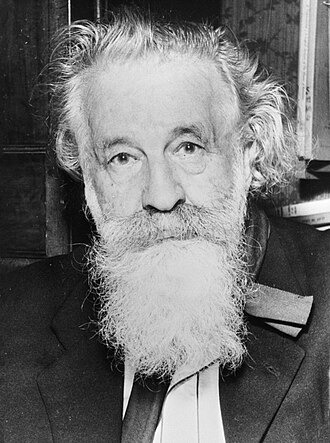
Gaston Bachelard was born in Bar-sur-Aube, France, on 27 June 1884 and died in Paris on 16 October 1962. Of modest origins, he worked in the postal service before turning to the study of science and then philosophy. He taught physics and chemistry at the Bar-sur-Aube college from 1919, took his doctorate in 1927, and was a professor at the University of Dijon from 1930 to 1940. In that year he took up the chair of history and philosophy of science at the Sorbonne, which he held until 1954, succeeding Abel Rey. Georges Canguilhem was his disciple and his successor at the Sorbonne.
His work has two sides, which he himself distinguished: a “diurnal” one devoted to epistemology and the history of the physical and chemical sciences, and a “nocturnal” one devoted to the poetic imagination. In the first stand out Le Nouvel esprit scientifique (1934), La Formation de l’esprit scientifique (1938), La Philosophie du non (1940) and Le Rationalisme appliqué (1949). In the second, La Psychanalyse du feu (1938), the series on the four elements (L’Eau et les rêves, 1942; L’Air et les songes, 1943; La Terre et les rêveries de la volonté and La Terre et les rêveries du repos, 1948), La Poétique de l’espace (1957) and La Poétique de la rêverie (1960). Bachelard held that the two sides do not mix: science demands rational discipline and vigilance against the imagination, whereas poetry demands surrender to the image.
Key Concepts
- Epistemological obstacle — in The Formation of the Scientific Mind (1938), Bachelard argues that scientific knowledge is built against earlier knowledge, and that the mind itself creates obstacles to progress. Among the obstacles he analyzes are first experience (immediate, enchanted observation), general knowledge, the verbal obstacle, and the substantialist and animist obstacles. The task would be a “psychoanalysis” of objective knowledge that purges it of these images.
- Epistemological break — science does not extend common sense by continuity but breaks with it and with its spontaneous representations; there are also breaks within the history of the sciences, such as those brought by non-Euclidean geometries and relativity. The concept was later taken up by Louis Althusser and other authors of the French structuralist tradition.
- New scientific spirit and the philosophy of No — contemporary science (relativistic physics, quantum mechanics) forces earlier concepts to be rectified; rationalism becomes open and “applied,” and Bachelard proposes a “non-Cartesian” epistemology that rejects simple and immutable ideas.
- Phenomenotechnique — the idea that scientific phenomena are largely produced and constructed by instruments and theories rather than simply given.
- Recurrent history — the historian of science judges the past in the light of present science, which determines what in the past was error or progress.
- Material imagination and reverie — on the poetic side, the imagination is tied to the elements (fire, water, air, earth) and to matter; poetic reverie is an activity of its own, distinct from dreaming.
- Topoanalysis — in The Poetics of Space (1957), Bachelard studies the spaces of intimacy through poetic images (the house, the nest, the shell, corners), in an approach of phenomenological inspiration.
Influenced by
- Léon Brunschvicg and Abel Rey — his doctoral supervisors and interlocutors in French philosophy of science
- Twentieth-century physics (relativity, quantum mechanics) and non-Euclidean geometries, the basis of his “new scientific spirit”
- Henri Bergson — a critical interlocutor, whom he answers in The Dialectic of Duration (1936)
- Freudian psychoanalysis and Jungian psychology — references, whether criticized or appropriated, in his studies of the imagination
- Phenomenology — a declared inspiration for the method of The Poetics of Space
Influenced
- Georges Canguilhem — disciple and successor, continuer of historical epistemology
- Louis Althusser — appropriation of the concept of epistemological break
- Michel Foucault — the epistemological historiography of Bachelard and Canguilhem figures among the sources of Foucault’s archaeology of knowledge
- Thomas Kuhn — often compared with Bachelard for discontinuity in scientific development, although direct influence is not established
- Studies of the imaginary, of poetics and literary criticism (for example, Gilbert Durand)
Works
Essai sur la connaissance approchée (1928); Le Nouvel esprit scientifique (1934); La Formation de l’esprit scientifique (1938); La Psychanalyse du feu (1938); La Philosophie du non (1940); L’Eau et les rêves (1942); Le Rationalisme appliqué (1949); La Poétique de l’espace (1957); La Poétique de la rêverie (1960).
See also
Thomas Kuhn, Karl Popper, Bergson, Husserl, Louis Althusser, Foucault