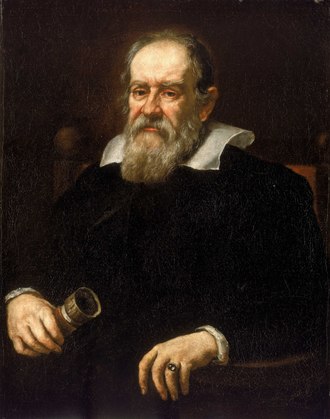
Born in Pisa in 1564, Galileo Galilei is often called the “father of modern science.” A professor of mathematics at Pisa and Padua, in 1609 he improved the newly invented telescope and turned it to the sky — with results that shook Aristotelian cosmology: mountains and craters on the Moon, four satellites orbiting Jupiter, the phases of Venus, spots on the Sun. The heavens, after all, were not the perfect, immutable realm they had been supposed to be.
A defender of Copernicus’s heliocentrism, Galileo came into collision with the Church. In 1633 he was tried by the Inquisition, forced to abjure his theses, and condemned to house arrest, in which he spent his final years, by then blind — a case that became a symbol of the conflict between science and dogma. Even so, he managed to publish his Two New Sciences (1638), founding modern mechanics.
More than an astronomer, Galileo was a philosopher of method. For him, “the book of nature is written in mathematical language”: to understand the world is to measure and quantify, not to seek essences or Aristotelian final causes. Uniting the mathematization of nature with the controlled experiment (real and idealized), he established the model for all the science that would come. His intuition of the principle of inertia directly prepared the laws of Newton, and his defense of the autonomy of scientific inquiry from theology marked Western culture forever.
Key Concepts
- Mathematical language of nature: “The book of nature is written in mathematical language” (Il Saggiatore)
- Telescope in astronomy: mountains on the Moon, 4 moons of Jupiter, phases of Venus — contradictions to celestial Aristotelianism
- Scientific method: hypothesis → deduction → experiment (idealized and real)
- Abandons Aristotelian final causes; focus on quantification, not essence
- Principle of inertia (anticipates Newton)
- Science and faith: separate domains
Influenced by
- Copernicus — heliocentrism
- Kepler — orbital laws (correspondence)
- Plato — the real is mathematical (methodological Platonism)
- Archimedes — geometry and mechanics
Influenced
- Newton — laws of motion and scientific method
- All modern science
Works
Sidereus Nuncius (1610); Il Saggiatore (1623); Dialogue Concerning the Two Chief World Systems (1632); Discourses and Mathematical Demonstrations Relating to Two New Sciences (1638).
See also
Scientific Revolution