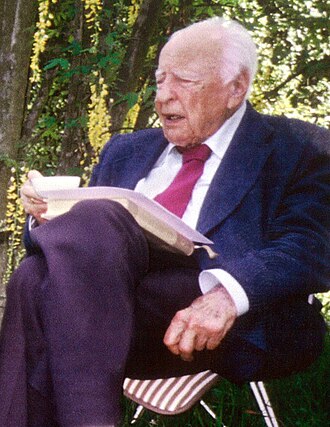
German philosopher; principal representative of philosophical hermeneutics in the 20th century. Student of Heidegger; his work Truth and Method (1960) reformulated the problem of understanding as a fundamental philosophical question.
Trained at Marburg in the climate of neo-Kantianism, Gadamer found in Heidegger the decisive turn of his career: the analytic of existence showed that understanding is not one intellectual operation among others but the very mode of being of human beings in the world. His early work centered above all on the Platonic dialogue and the dialectical ethics of Plato, and it was only in maturity — when he already held the chair at Heidelberg — that he published the book that would make his name, written when he was already sixty. Living through the Nazi years without joining the Party — though, like many academics, he signed the 1933 professors’ oath of loyalty to the new regime — and surviving two world wars, Gadamer would gain international recognition only in the second half of the century, becoming one of the most long-lived and respected philosophical voices in Europe.
The central target of Truth and Method is the claim of scientific method to monopolize access to truth. Against this reduction, Gadamer recovers the experience of truth that occurs in art, history, and language — domains in which meaning is not “produced” by a neutral subject but arises from our belonging to a tradition that precedes and constitutes us. To understand, on this view, is always to interpret from within a concrete historical situation, in a movement in which interpreter and interpreted are mutually implicated. This thesis shifted hermeneutics from a mere technique for reading texts toward a reflection on the finitude and historicity of all human understanding, with lasting effects on philosophy, the theory of interpretation, law, and the human sciences.
Key Concepts
- Philosophical hermeneutics: understanding is not a scientific method — it is the mode of being of historical Dasein; not something we do, but something that happens to us
- Hermeneutic circle: understanding a text requires pre-understanding (of the whole), which is revised by the parts, which are illuminated by the revised whole — ascending spiral, not vicious circle
- Prejudice (Vorurteil): rehabilitates prejudices (pre-judgments) as a condition of all understanding — they are not obstacles to overcome, but structures of openness to the world; the Enlightenment erred in denouncing all prejudice
- Tradition and authority: tradition transmits sedimented truths that critical reason cannot simply discard — it is a condition of our hermeneutic situation
- Fusion of horizons (Horizontverschmelzung): in understanding a text from the past, the interpreter’s horizon and the text’s horizon fuse; there is no “pure” access to the original meaning (against Dilthey’s historicism)
- Language as universal medium: “Being that can be understood is language”; all human experience is mediated by language — hermeneutics is the universal dimension of philosophy
- Dialogue: authentic conversation is the model of understanding — the other tells us something we did not know; the question opens the horizon
Influenced by
- Heidegger — being-in-the-world, historicity, language
- Hegel — dialectics and historical mediation
- Plato — Socratic dialogue as model
- Friedrich Schleiermacher — romantic hermeneutics (critical starting point)
- Wilhelm Dilthey — hermeneutics of human sciences (supersedes)
Influenced
- Paul Ricoeur — hermeneutics of text and narrative
- Habermas — famous debate on tradition vs. critique (Gadamer-Habermas)
- Literary theory (reception: Jauss, Iser)
- Philosophy of law and bioethics
Works
Truth and Method (1960); Reason in the Age of Science (1976); Praise of Theory (1983); The Heritage of Europe (1989).
See also
Twentieth-Century Philosophy