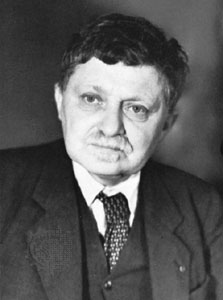
Gabriel Marcel was born in Paris on 7 December 1889 and died in the same city on 8 October 1973. A philosopher, playwright, drama critic and musician, he converted to Catholicism in 1929. He did not pursue a conventional academic career: he taught for a time in secondary schools, worked as a critic and editor, and wrote some thirty plays, which he regarded as an inseparable part of his philosophical work. He delivered the Gifford Lectures at Aberdeen (1949–1950), published as Le Mystère de l’être (1951), and the William James Lectures at Harvard (1961–1962). His philosophy, generally unsystematic, proceeds by meditations on concrete experience, and Journal métaphysique (1927), written in diary form, is his first major text.
The label “Christian existentialism,” popularized by Jean-Paul Sartre in Existentialism Is a Humanism, was at first accepted by Marcel and later repudiated by him, since he felt the term aligned him with a philosophy from which he diverged radically.
Key Concepts
- Problem and mystery — a central distinction: a problem is an external question that can be objectified and solved; a mystery is a question in which the subject is involved and which cannot be treated as if he or she stood outside it (being, freedom, love, death).
- Primary and secondary reflection — primary reflection analyzes and abstracts, treating the real as an object; secondary reflection recovers the unity of lived experience and is the method of the concrete philosophy Marcel defends.
- Being and having — in Être et avoir (1935), he contrasts the relation of possession, which objectifies and dominates, with a relation of being, of participation; modern life, he holds, tends to turn the human being into a bearer of functions.
- Availability and fidelity — availability (disponibilité) is openness to the other; creative fidelity is perseverance in a commitment that is not reducible to a rule but is a response to a call.
- Intersubjectivity — the “I–Thou” relation precedes knowledge of objects; the other is not a datum but a presence to which one responds. This theme brings Marcel close to Martin Buber, though the development is independent.
- Hope — in Homo viator (1944), hope appears as a response to despair, rooted in trust in Being rather than mere optimism.
- Critique of technical society — in Les hommes contre l’humain (1951) and other writings, he criticizes the “spirit of abstraction” and the functionalization of the person.
Influenced by
- Henri Bergson, for his valuing of concrete experience
- Josiah Royce, to whom he devoted studies and whose notion of community marked him
- The novel and the theater as fields of conceptual elaboration
Influenced
- Paul Ricoeur, who devoted Gabriel Marcel et Karl Jaspers (1947) to him and took part in the gatherings around Marcel
- The philosophy of the person and French personalism, with Emmanuel Mounier
- The twentieth-century philosophy of dialogue and ethics of otherness, in parallel with Emmanuel Lévinas
- Christian reflection on hope and the existential tradition in the philosophy of religion
Works
Journal métaphysique (1927); Position et approches concrètes du mystère ontologique and Le monde cassé (1933); Être et avoir (1935); Du refus à l’invocation (1940); Homo viator (1944); Le mystère de l’être (1951); Les hommes contre l’humain (1951); L’homme problématique (1955).
See also
Karl Jaspers, Søren Kierkegaard, Jean-Paul Sartre, Josef Pieper, Jacques Maritain