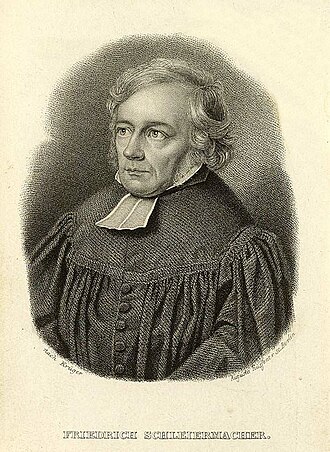
Friedrich Daniel Ernst Schleiermacher was born in Breslau (present-day Wrocław, Poland) on 21 November 1768 and died in Berlin on 12 February 1834. Son of a Reformed army chaplain, he studied at the Moravian seminary in Barby and subsequently at Halle. He became a preacher in Berlin, held a professorship in Halle (1804–1807), and from 1810 was professor of theology and philosophy at the newly founded University of Berlin — of which he was one of the principal intellectual architects, alongside Wilhelm von Humboldt and Fichte.
Schleiermacher holds a dual place in the history of philosophy: as a theologian, he reformulated the understanding of religious experience within German Romanticism; as a philosopher of language and interpretation, he founded general hermeneutics — a philosophical theory of understanding as such, beyond the specialized applications to biblical exegesis or law.
Key Concepts
General hermeneutics: Before Schleiermacher, hermeneutics was a fragmented auxiliary discipline — there was biblical (theological) hermeneutics and legal hermeneutics, each with its own particular canons. Schleiermacher’s lectures (especially after 1819) propose a general theory of understanding applicable to any text and any discourse. Misunderstanding — not understanding — is the natural state; the interpreter must actively reconstruct meaning. This reformulation made hermeneutics a first-order philosophical discipline.
Grammatical interpretation and psychological (technical) interpretation: Full understanding of a text requires two complementary movements. Grammatical interpretation (objective) examines the text in light of the shared language of its era — lexicon, grammar, conventional usage. Psychological interpretation (or technical, subjective) seeks to reconstruct the individual creative process of the author — what Schleiermacher calls “divination” (Divination): an intuition that goes beyond rules and captures the singular style and intention of the writer.
Hermeneutic circle: The part is understood only in light of the whole; the whole is understood only through the composition of the parts. This principle, already present in earlier hermeneuticists (Ast, Wolf), is systematized by Schleiermacher: it applies both at the grammatical level (sentence / work) and at the psychological level (individual thought / the author’s life context). The circle is not vicious — it is the very structure of understanding.
Divination (Divination): The non-algorithmic moment of interpretation — the interpreter’s intuitive capacity to transpose themselves into the author’s mental horizon, identifying what is singular and irreducible to rules. Schleiermacher distinguishes it from comparative interpretation (which applies general rules): divination is indispensable for singular texts and for authors of distinctive style.
Religion as feeling of absolute dependence (schlechthinniges Abhängigkeitsgefühl): In theology, Schleiermacher situates the religious phenomenon not in metaphysical speculation nor in practical morality, but in the domain of feeling — specifically, the feeling of absolute dependence in relation to the infinite. This formulation, developed in the Speeches on Religion (1799) and systematized in the Glaubenslehre (Christian Faith, 1821–1822), represents a response to the Enlightenment challenge: religion is irreducible to theoretical reason or ethics, because it possesses its own form of experience.
Translation and interpretation of Plato: Schleiermacher produced the first systematic translation of Platonic dialogues into German (6 vols., 1804–1828), accompanied by introductions that remain influential. His principle of philosophical translation — respecting the target language without betraying the spirit of the original — and his reading of the order of the Platonic dialogues profoundly influenced Platonic hermeneutics.
Ethics and dialectics: Beyond hermeneutics and theology, Schleiermacher developed an ethics grounded in individual Bildung (formation) within community, and a dialectics (theory of knowledge and discourse) that relates thought, language, and being — anticipating themes that Gadamer and analytic philosophy of language would later explore.
Influenced by
- German Romanticism (Novalis, Friedrich Schlegel — direct friendship in Berlin, c. 1797–1800) — valorization of the individual, the historical, the expressive
- Kant — distinction of domains (theoretical reason, practical reason, feeling/aesthetic); critique of dogmatism
- Spinoza — pantheism and the feeling of the infinite (mediated by the Berlin circle)
- Plato — as translator and interpreter; dialogue as an exemplary philosophical form
- Friedrich Ast and F.A. Wolf — classical hermeneutics and philology as critical starting points
Influenced
- Wilhelm Dilthey — hermeneutics of the human sciences; Verstehen as method
- Hans-Georg Gadamer — Truth and Method (1960) departs from a productive critique of Schleiermacher: accepts the hermeneutic circle, rejects the psychologism of divination
- Paul Ricoeur — integrates Schleiermacher into the genealogy of hermeneutics
- Liberal theology of the 19th–20th centuries (Adolf von Harnack, Ernst Troeltsch) — historical-critical method in theology
- Translation studies (Übersetzungstheorie) — his essay Über die verschiedenen Methoden des Übersetzens (On the Different Methods of Translating, 1813) is a foundational text in the field
Works
Über die Religion: Reden an die Gebildeten unter ihren Verächtern (On Religion: Speeches to Its Cultured Despisers, 1799; rev. 2nd ed. 1806); Monologen (1800); German translation of Plato’s dialogues (6 vols., 1804–1828); Über die verschiedenen Methoden des Übersetzens (1813); Der christliche Glaube (The Christian Faith, 1821–1822; rev. 2nd ed. 1830); Hermeneutik und Kritik (posthumous publication, 1838, from manuscripts and lecture notes).
See also
Nineteenth-Century Philosophy; Dilthey; Gadamer; Ricoeur; German Romanticism
Recommended Books:
 Hermeneutics and Criticism — Friedrich Schleiermacher (trans. Andrew Bowie, Cambridge UP)
Ver na Amazon →
Hermeneutics and Criticism — Friedrich Schleiermacher (trans. Andrew Bowie, Cambridge UP)
Ver na Amazon →