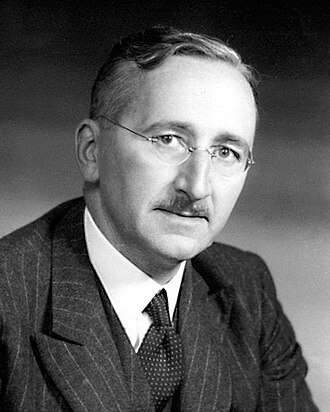
Friedrich August von Hayek was born in Vienna on 8 May 1899 and died in Freiburg im Breisgau on 23 March 1992. He earned doctorates in law (1921) and political science (1923) at the University of Vienna and was formed in the Austrian School of economics under the influence of Carl Menger and Ludwig von Mises. From 1931 he taught at the London School of Economics, where he debated John Maynard Keynes on business cycles and monetary policy; after the war he moved through Chicago (Committee on Social Thought, from 1950), Freiburg, and Salzburg. In 1947 he took part in founding the Mont Pelerin Society. In 1974 he received the Sveriges Riksbank Prize in Economic Sciences in Memory of Alfred Nobel, shared with Gunnar Myrdal, for pioneering work on the theory of money and economic fluctuations and for analysis of the interdependence of economic, social, and institutional phenomena.
His work moves from economic theory (Prices and Production, 1931) toward the epistemology of the social sciences and political and legal philosophy. In The Road to Serfdom (1944) he argued that central economic planning tends to erode individual freedoms and the rule of law; the book nevertheless allows state functions such as a minimal safety net, which distinguishes it from libertarian caricatures.
Key Concepts
- Dispersed knowledge — in “The Use of Knowledge in Society” (1945), he holds that knowledge relevant to economic action is distributed among individuals, largely tacit and local, and cannot be gathered by a central planner; the price system works as a mechanism for communicating this information.
- Spontaneous order — social orders (market, language, common law) result from human action but not from human design; Hayek distinguishes kosmos (spontaneous order) from taxis (made order) and uses “catallaxy” for the market order.
- Constructivist vs. evolutionary rationalism — a critique of the pretension to redesign institutions by reason, in favor of a tradition going back to Hume, Adam Smith, and Adam Ferguson.
- Rule of law — general, abstract, predictable rules applied equally as the condition of liberty; liberty is understood as the absence of arbitrary coercion.
- Critique of “social justice” — in Law, Legislation and Liberty (1973–1979), he argues that in a spontaneous order the distribution of outcomes is not the product of intention and therefore cannot be called just or unjust.
- Competition as a discovery procedure — the market as a process through which information is revealed that would otherwise remain unknown.
Criticism
Keynes and Keynesians contested his business-cycle theory and his opposition to countercyclical policy. John Rawls and other theorists of distributive justice reject the claim that social justice is an empty notion. Critics also argue that spontaneous order, as described, may naturalize historical inequalities and underrate market failures and asymmetries of power; his openness, in interviews of the 1980s, to transitional dictatorships in the Chilean context was the target of strong controversy. In “Why I Am Not a Conservative” (postscript to The Constitution of Liberty), Hayek rejected the conservative label and preferred that of “old Whig.”
Influenced by
- Carl Menger and Ludwig von Mises — the Austrian School and the critique of socialist economic calculation
- Hume and Adam Smith — Scottish moral philosophy and spontaneous order
- Karl Popper — friendship and affinity in anti-utopian planning and fallibilism
- Kant — influence on the conception of general, universalizable rules (as read by commentators)
Influenced
- Milton Friedman and the Chicago School, in convergences and divergences
- Scholars of law and public choice, such as James Buchanan
- Liberal economic policy of the 1970s–1980s, sometimes citing Hayek in ways his commentators consider simplifying
Works
Prices and Production (1931); The Road to Serfdom (1944); Individualism and Economic Order (1948); The Sensory Order (1952); The Counter-Revolution of Science (1952); The Constitution of Liberty (1960); Law, Legislation and Liberty (3 vols., 1973–1979); The Fatal Conceit (1988).
See also
Karl Popper, Adam Smith, Hume, John Rawls, Edmund Burke, Hans Kelsen, John Stuart Mill