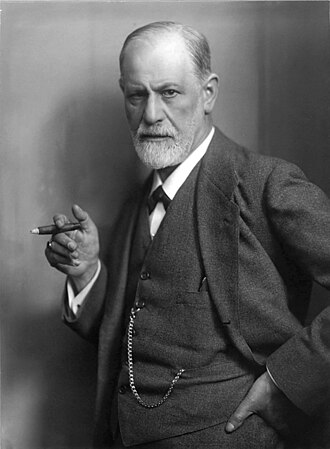
Neurologist and founder of psychoanalysis. Although not strictly a philosopher, his theory of the unconscious, drives, and repression became one of the most influential philosophical matrices of the 20th century, especially for the Frankfurt School, existentialism, and post-structuralism.
Key Concepts
- Unconscious: the greater part of mental life escapes consciousness; repressed desires, traumas, and conflicts determine behavior. The unconscious does not obey logic or linear time
- Psychic topography:
- First topography: Unconscious / Preconscious / Conscious
- Second topography: Id (primitive drives) / Ego (mediation with reality) / Superego (internalization of social norms)
- Drives: Eros (drive for life, love, creativity) and Thanatos (death drive, aggression, repetition) — fundamental conflict of the psyche
- Repression: civilization demands the repression of drives; the cost is neurosis. Central theme of Civilization and Its Discontents (1930)
- Oedipus complex: desire for the parent of the opposite sex and rivalry with the same-sex parent; structure of entry into culture and formation of the superego
- Dreams, slips, and symptoms: “Royal road to the unconscious” — encrypted language of repressed desires
- Critique of religion: The Future of an Illusion (1927) — religion is childish illusion of a protective father; Totem and Taboo — origin of religion in primordial patricide
Influenced by
- Charles Darwin — drives and biological evolution
- Nietzsche — critique of morality, unconscious forces (notable parallels)
- Franz Brentano — philosophy of mind and intentionality
Influenced
- Marcuse — Eros and Civilization: freedom vs. capitalist over-repression
- Adorno and Horkheimer — social unconscious, authoritarianism
- Walter Benjamin — dream, dialectical image
- Sartre — critiques psychoanalysis but engages with it (bad faith vs. repression)
- Simone de Beauvoir — psychoanalysis and the construction of the feminine
- Derrida — trace, différance and the unconscious as writing
- Foucault — critiques the apparatus of sexuality in The History of Sexuality
- Jacques Lacan — structuralist rereading of Freud
Works
The Interpretation of Dreams (1900); Three Essays on the Theory of Sexuality (1905); Totem and Taboo (1913); Introductory Lectures on Psychoanalysis (1916–17); The Ego and the Id (1923); The Future of an Illusion (1927); Civilization and Its Discontents (1930); Moses and Monotheism (1939).
See also
Twentieth Century Philosophy