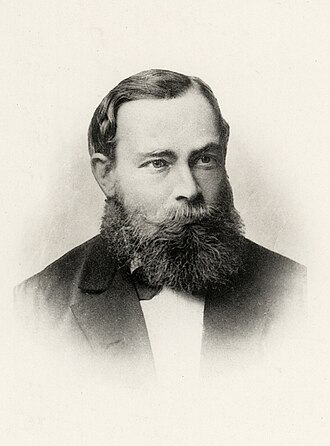
A German mathematician born in 1848, Gottlob Frege spent almost his entire career as a professor at Jena, in relative obscurity — his genius would be fully recognized only after his death, in 1925, above all thanks to Russell, Wittgenstein, and the Vienna Circle. Today he is regarded as the founder of modern logic and one of the fathers of analytic philosophy.
His first great achievement was the creation, in the Begriffsschrift (1879), of a predicate logic that retired the old Aristotelian syllogistic: with quantifiers (“for all,” “there exists”), variables, and functions, Frege gave logic the precision and expressive power it needed to analyze mathematics. His larger aim was logicism — to demonstrate that arithmetic reduces to pure logic. The project, set out in the Basic Laws of Arithmetic, was struck head-on by a letter from Russell (1902) revealing a contradiction in the system; Frege never fully recovered from the blow.
His most famous contribution to the philosophy of language is the distinction between sense (Sinn) and reference (Bedeutung). “The morning star” and “the evening star” have the same reference — the planet Venus — but different senses, since they present the object in different ways. This distinction, together with the thesis that thoughts are objective entities (and not private psychological states), became the foundation of all twentieth-century semantics and philosophy of language, influencing figures from Russell and Wittgenstein to Carnap, Quine, and Dummett.
Key Concepts
- Predicate logic (Begriffsschrift, 1879): created the logical notation that replaced Aristotelian syllogistic — quantifiers (∀, ∃), variables, functions and arguments. Technical foundation of modern mathematical logic
- Logicism: arithmetic is reducible to pure logic — numbers are logical objects (extensions of concepts). Attempt expounded in Grundgesetze; Russell’s paradox showed an inconsistency in the system
- Sense (Sinn) and reference (Bedeutung): “The morning star = the evening star” — both refer to the same object (Venus) but have different senses. Fundamental distinction: reference is the object; sense is the mode of presentation of the object
- Thoughts as abstract objects: thoughts (propositions) are neither mental events nor physical objects — they belong to a “third realm,” objective and non-psychological; different people can grasp the same thought
- Context: the meaning of a word is determined only in the context of a proposition — principle of context (Grundlagen)
Influenced by
- Kant — foundations of arithmetic (point of departure)
- Leibniz — ideal of a characteristica universalis (universal logical language)
- Boole — logical algebra (surpassed)
Influenced
- Russell — adapted Frege’s logic; Russell’s paradox affected Frege’s logicism
- Wittgenstein — Tractatus uses Frege’s semantics
- Vienna Circle — logical positivism
- Michael Dummett, Quine — contemporary analytic philosophy
Works
Begriffsschrift (1879); The Foundations of Arithmetic (1884); On Sense and Reference (1892); The Basic Laws of Arithmetic (1893–1903).
See also
Twentieth-Century Philosophy