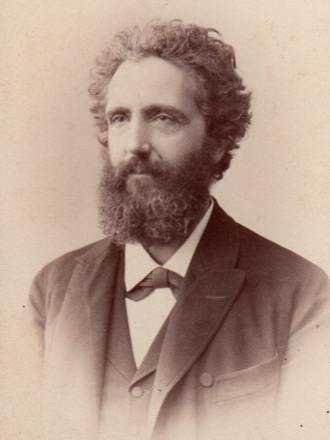
Franz Brentano (1838–1917) was an Austrian-German philosopher whose work marks one of the quiet turning points of modern philosophy. Born at Marienberg am Rhein into a Catholic family of Italian origin — he was a nephew of the Romantic poet Clemens Brentano — he took his doctorate at Tübingen in 1862 with the thesis Von der mannigfachen Bedeutung des Seienden nach Aristoteles (“On the Several Senses of Being in Aristotle”), a study that the young Martin Heidegger read in his adolescence and that would shape an entire twentieth-century lineage of return to Aristotle. Ordained a Catholic priest in 1864, he completed his Habilitation at Würzburg in 1866 and resigned from the priesthood in 1873 amid the crisis opened by the dogma of papal infallibility (Vatican I, 1870). In Vienna, where he taught from 1874 to 1895, he gathered a remarkable constellation of pupils — Husserl, Meinong, Twardowski, Stumpf, Ehrenfels, Marty — out of whom phenomenology, object theory, and the Lvov-Warsaw School would emerge. He lost his chair in 1880 because he married (Austrian law treated former priests as still bound by their vow of celibacy) and was reduced to Privatdozent. He retired in 1895 and lived first in Florence and then in Zurich, where he died, blind, in 1917.
Key Concepts
- Intentionality (Psychologie vom empirischen Standpunkt — Psychology from an Empirical Standpoint, 1874): every mental phenomenon is characterised by its directedness toward an object — an “intentional in-existence” (intentionale Inexistenz) of a content, an expression Brentano recovers from the medieval schoolmen. Absent from physical phenomena, this feature became the classical criterion for distinguishing the mental from the non-mental.
- Classification of mental phenomena (Psychologie, 1874): against the traditional triad of thinking, feeling, and willing, Brentano organises mental life into three fundamental classes — presentations (Vorstellungen); judgements (the affirming or denying of the existence of what is presented); and phenomena of love and hate (affects, emotions, and acts of the will treated as a single class of evaluative stances).
- The several senses of being in Aristotle (doctoral thesis, 1862): Brentano organises the Aristotelian pollachôs legetai to on into a systematic architecture — being as the categories, as act and potency, as the true, as the accidental — and so opened the path to Heidegger’s ontological reading of Aristotle.
- The ethics of correct moral knowledge (Vom Ursprung sittlicher Erkenntnis — The Origin of Our Knowledge of Right and Wrong, 1889): there are acts of love and hate that are “evidently correct,” analogous to evidently true judgements; the good is the object of a preference whose correctness can be intuited directly, anchoring ethics in axiological experience rather than in utility or imperatives.
- Descriptive versus genetic psychology: philosophy of mind must begin by rigorously describing the kinds and structures of psychical acts before seeking their causes — a programme that Husserl would translate into descriptive phenomenology.
- The late “reism” (manuscripts c. 1904–1917): Brentano abandons any commitment to non-real entities (propositions, states of affairs, non-existent objects) and holds that only individual things (res) exist; intentionality is then reconceived as a peculiar relation of the subject to things, not to “contents.”
Influenced by
- Aristotle — doctrine of the soul, of mental acts, and of the senses of being
- Thomas Aquinas and the schoolmen — the medieval notion of the esse intentionale of the object in the mind
- British philosophy — J. S. Mill (with whom he corresponded) and the empiricist tradition, the model for an “empirical standpoint”
- Leibniz and Descartes — the primacy of consciousness and of descriptive introspection
Influenced
- Husserl — his student in Vienna between 1884 and 1886; phenomenology inherits intentionality and descriptive psychology from him
- Alexius Meinong — object theory, non-existent objects
- Kazimierz Twardowski — founder of the Lvov-Warsaw School, the matrix of Polish logic
- Carl Stumpf and Christian von Ehrenfels — gestalt-precursor psychology
- Anton Marty — Brentanian philosophy of language
- Sigmund Freud — attended his Vienna lectures (1874–76) before turning to medicine
- Roderick Chisholm — reintroduced “Brentano’s thesis” into analytic philosophy of mind in the 1950s
Works
What Brentano published in his lifetime is smaller than what circulated in manuscripts, notebooks, and lecture courses. The landmarks in print are the 1862 dissertation Von der mannigfachen Bedeutung des Seienden nach Aristoteles (“On the Several Senses of Being in Aristotle”); Die Psychologie des Aristoteles (“The Psychology of Aristotle,” 1867); and above all Psychologie vom empirischen Standpunkt (“Psychology from an Empirical Standpoint,” 1874; revised second edition published posthumously in 1924), his magnum opus and the starting point of twentieth-century philosophy of mind. Vom Ursprung sittlicher Erkenntnis (“The Origin of Our Knowledge of Right and Wrong,” 1889) condenses his ethics. Kategorienlehre (“The Theory of Categories,” 1933) and Wahrheit und Evidenz (“Truth and Evidence,” 1930), both posthumous, were assembled by disciples from manuscripts; the critical edition of his Nachlass is still in progress, so that Brentano’s work itself remains a living field of research.
See also
Husserl, Aristotle, Heidegger