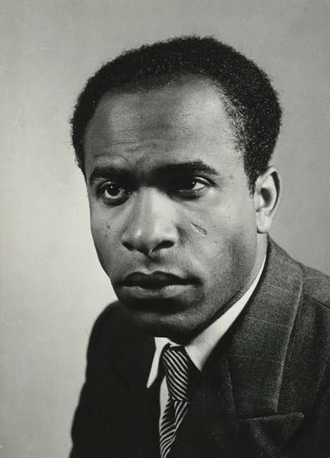
Frantz Omar Fanon was born on 20 July 1925 in Fort-de-France, Martinique (then a French colony). A psychiatrist, essayist, and political militant, he is the most influential figure of African and Caribbean anticolonial philosophy. Trained in medicine and psychiatry in France (Lyon), he served as chief of psychiatry at the Blida-Joinville Hospital in Algeria from 1953. Confronted with the atrocities of the Algerian War of Independence (1954–1962), he joined the FLN (National Liberation Front) and became one of the principal intellectual voices of the anticolonial cause. He died of leukemia in Bethesda, Maryland, on 6 December 1961, aged 36, days after the publication of Les damnés de la terre.
Key Concepts
Colonialism as structural violence: Fanon analyzes colonialism not merely as political and economic domination, but as a system that violates the psychic and ontological integrity of the colonized. The colony is a world spatially divided in two: the settler’s quarter (bright, solid) and the colonized’s quarter (dark, precarious). This spatial division is also a division of humanity.
The racial epidermal schema (Black Skin, White Masks, 1952): Fanon’s first work is a psychoanalysis of Antillean colonialism. The Black man, living under white domination, internalizes a negative self-image and aspires to be recognized by the white gaze — a process Fanon describes as existential alienation. Black consciousness is caught in the tension between the colonizer’s language (which confers civilization) and skin color (which returns one to inferiorization). Fanon draws on Sartre, Hegel (dialectic of recognition), Lacan, and Merleau-Ponty to analyze this condition — while simultaneously criticizing them for their blindness to racism.
The racial epidermal schema: Fanon distinguishes Merleau-Ponty’s “bodily schema” (the lived experience of the body as a field of possibilities) from the “racial epidermal schema”: the Black man is not simply a lived body, but a body marked by the white gaze that fixes him in his color. The experience of being Black in the colonial world is to be reduced to the epidermis — to be defined by a surface layer that carries an immense historical and symbolic weight.
Decolonizing violence (The Wretched of the Earth, 1961): Fanon’s most radical work argues that colonial violence structures the colonized so deeply that only the violence of armed struggle can rupture this structure and create a new humanity. Violence is not simply a strategic means: it is a process of re-humanization of the colonized who, by confronting the settler as an adversary, reclaims agency and dignity. This thesis is among the most debated in all of twentieth-century political philosophy; Hannah Arendt criticized it sharply in On Violence (1970).
The wretched of the earth: The title echoes the first words of the Internationale (“arise, ye wretched of the earth”). Fanon is not writing only about Algeria, but elaborating a general theory of the colonial condition: African peasants, colonial subproletarians, and the dispossessed masses are the revolutionary force of the twentieth century — not the European industrial proletariat. Decolonization is not simply the transfer of power to national elites, but the creation of a “new humanity” that surpasses the colonizer/colonized dichotomy.
Critique of postcolonial nationalism: Fanon warns against the trap of nationalism among African elites who, after independence, reproduce colonial structures under new ownership. The African national bourgeoisie, for Fanon, is incapable of genuine revolution; the risk of formal independence is that it benefits only a minority while leaving the masses in the same misery.
Critique of Négritude: Fanon acknowledges the affirmative value of Senghor and Césaire’s Négritude as a necessary moment of identity recognition, but criticizes it as a position that becomes reactive and essentialist: to define the Black person by intuitive sensibility, by connection to earth and rhythm, is to accept the terms of inverted racism. The goal is not to be a proud Negro, but to be a free human being.
Influenced by
- Hegel — master-slave dialectic; recognition
- Sartre — existentialism, freedom, bad faith; preface to The Wretched of the Earth
- Merleau-Ponty — phenomenology of the body and bodily schema
- Karl Marx — class analysis, mode of production, alienation
- Aimé Césaire — Négritude (incorporated critically)
- Sigmund Freud / Lacan — psychoanalysis applied to racism
Influenced
- Postcolonial and decolonial studies (Homi Bhabha, Stuart Hall, Walter Mignolo)
- Black Power and civil rights movements in the USA
- African liberation philosophy (Cabral, Rodney)
- Achille Mbembe — Necropolitics
- African liberation movements (Angola, Mozambique, Guinea-Bissau)
Works
Black Skin, White Masks (1952); A Dying Colonialism (1959); The Wretched of the Earth (1961, preface by Jean-Paul Sartre); Toward the African Revolution (posthumous collection, 1964).
See also
African Philosophy Twentieth-Century Philosophy