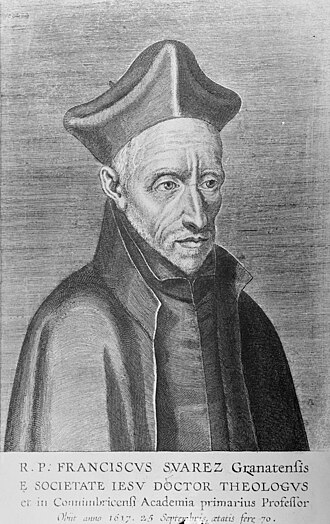
Francisco Suárez was born in Granada on 5 January 1548 and died in Lisbon on 25 September 1617. He entered the Society of Jesus in 1564, studied at Salamanca, and taught philosophy and theology at Segovia, Valladolid, Rome (Roman College), Alcalá, Salamanca and, from 1597, Coimbra, where he remained until shortly before his death. He is the most influential figure of so-called Second Scholasticism, the revival of scholastic thought in the sixteenth and seventeenth centuries, especially on the Iberian Peninsula, in which Thomism and other medieval currents were reworked in dialogue with the questions of the age.
His major philosophical work is the Disputationes metaphysicae (Salamanca, 1597), a treatise in 54 disputations that presents metaphysics systematically, organized by topics and problems rather than as a linear commentary on Aristotle. The work served as a textbook and reference in Catholic and Protestant universities for over a century and is one of the channels through which scholastic ontology reached modern thought. In it Suárez defends positions that set him apart from Thomas Aquinas and bring him, on some points, closer to Duns Scotus: he holds that the essence and existence of creatures are distinguished only conceptually (a distinction of reason), not really; that the individual is individuated by its whole entity and not by an additional principle such as matter; and he conceives the object of metaphysics as real being, that is, what has or can have real essence.
In the political and legal field, De legibus ac Deo legislatore (Coimbra, 1612) develops a theory of law (eternal, natural, positive), characterizing human law as a common, just, stable and sufficiently promulgated precept. According to Suárez, political power originates in God as author of human social nature, but resides originally in the community, which transfers it to the ruler; hence limits on power and, in extreme cases of tyranny, the possibility of resistance. He distinguishes natural law from the ius gentium, which he conceives as human positive law of customary basis, formed among peoples. In Defensio fidei catholicae et apostolicae adversus anglicanae sectae errores (1613), written at the pope’s request, he answered James I of England’s defence of the oath of allegiance, and the work was publicly burned in London in the same year.
Key Concepts
- Systematic metaphysics — presentation of metaphysics as the science of being qua being, in topical disputations (Disputationes metaphysicae, 1597).
- Distinction of reason between essence and existence — rejection of the Thomist real distinction in favour of a merely conceptual distinction in creatures.
- Individuation by total entity — individuality belongs to the whole being, not to an added principle.
- Theory of law — eternal, natural and positive law, and the definition of law as a common, just, stable and promulgated precept (De legibus, 1612).
- Communal origin of political power — power comes from God through the community, which transfers it to the ruler.
- Ius gentium — law among peoples, of customary basis, distinct from natural law.
Influenced by
- Thomas Aquinas — central reference of his commentary and theology
- Duns Scotus — closeness on themes such as individuation and the concept of being
- Aristotle — base text of scholastic metaphysics
- Francisco de Vitoria and the School of Salamanca — the tradition of moral and legal theology in which he was formed
Influenced
- Descartes and Leibniz — readers of late scholasticism, in whose context the Disputationes were a work of reference
- Christian Wolff and German school metaphysics — through the systematic organization of the discipline
- Hugo Grotius — cites Second Scholastic authors, Suárez among them, in De iure belli ac pacis (1625)
- Neo-scholasticism and the history of modern ontology
Works
Disputationes metaphysicae (1597); De legibus ac Deo legislatore (On Laws and God the Lawgiver, 1612); Defensio fidei catholicae et apostolicae adversus anglicanae sectae errores (1613); De anima (posthumous, 1621).
See also
Thomas Aquinas, Duns Scotus, Francisco de Vitoria, Descartes, Leibniz