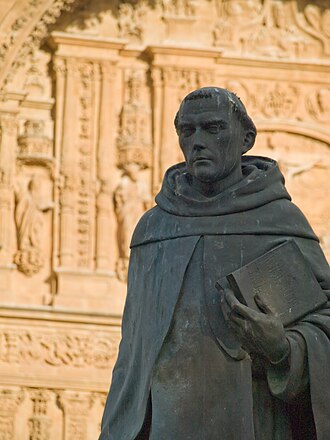
Francisco de Vitoria was born between c. 1483 and 1486 (the date and the place, Burgos or Vitoria, are disputed) and died in Salamanca on 12 August 1546. A Dominican friar, he studied in Paris, where he became familiar with the method of commenting on the Summa theologiae of Thomas Aquinas, and taught there before returning to Spain. He lectured at Valladolid and, from 1526, held the principal chair of theology at the University of Salamanca, where he adopted the Summa as the reference text in place of Peter Lombard’s Sentences. He is regarded as the founder of the School of Salamanca, a group of sixteenth-century theologians and jurists (among them Domingo de Soto and Melchor Cano) who renewed scholasticism and which later counted Francisco Suárez among its heirs.
Vitoria published nothing in his lifetime: his thought reaches us through lecture notes and his Relectiones, solemn lectures delivered at Salamanca and edited posthumously (Lyon, 1557). Among them stand out De potestate civili (1528), on the origin and limits of political power, and the two relectiones of 1539, De Indis (or De Indis recenter inventis) and De iure belli (or De Indis sive de iure belli Hispanorum in barbaros), written in the context of the Spanish conquest of the Americas and the controversies over the status of the indigenous peoples.
In De Indis Vitoria examines the titles invoked to justify Spanish domination. Among others, he rejects the universal authority of the emperor and the pope over the world, mere discovery, and the indigenous refusal to accept the Christian faith, and he affirms that the indigenous peoples were true public and private lords of their goods and communities. He admits as possibly legitimate titles the right of communication and free passage (ius communicationis), trade, the preaching of the Gospel under conditions of freedom, and the defence of innocents against practices such as human sacrifice. These arguments have received divergent readings: some see in them a pioneering defence of the rights of peoples, while others, such as Antony Anghie, argue that the Vitorian framework supplied legal justifications for colonial intervention.
In De iure belli, war is just only when it answers an injury received, and difference of religion is not a just cause. Vitoria conceives the community of nations as a “whole” (totus orbis) governed by the ius gentium, a law that derives from natural reason and binds peoples to one another, which made him a reference in the history of international law, a theme discussed by James Brown Scott in the twentieth century.
Key Concepts
- Law of nations (ius gentium) — law derived from natural reason that binds political communities to one another.
- Dominion of the indigenous peoples — recognition that the indigenous had true ownership and powers of their own (De Indis, 1539).
- Legitimate and illegitimate titles — critical examination of the arguments used to justify the conquest.
- Just war — an injury received is the only just cause; religion and expansion of dominion are not (De iure belli, 1539).
- Relectio — a university genre of solemn lecture on a specific topic, through which Vitoria set out his thought.
- Origin of civil power — power originates in God and is exercised through the community (De potestate civili, 1528).
Influenced by
- Thomas Aquinas — main source of his moral and political theology
- The Parisian masters of his time, where he received his scholastic training
- The tradition of Roman and canon law, from which he draws the concept of ius gentium
Influenced
- Domingo de Soto and Melchor Cano — disciples and continuators in the School of Salamanca
- Francisco Suárez — heir to the Salamancan tradition of legal theology
- Hugo Grotius and the history of modern international law, in which his work is discussed as a forerunner
- Carl Schmitt — discusses Vitoria in Der Nomos der Erde (1950)
Works
De potestate civili (1528); De Indis (1539); De iure belli (1539); Relectiones theologicae (posthumous, Lyon, 1557); commentaries on the Summa theologiae of Thomas Aquinas.