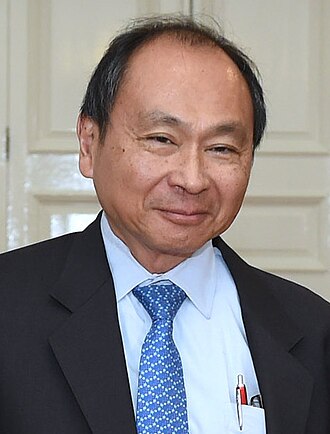
Francis Yoshihiro Fukuyama (1952–) was born in Chicago, the son of a second-generation Japanese-American Protestant minister with a doctorate in sociology and of a woman born in Kyoto, daughter of the economist Shiro Kawata, founder of the Economics Department at Kyoto University. He earned a degree in classics from Cornell University — where he studied under Allan Bloom — and a doctorate in political science from Harvard University. He was serving on the Policy Planning Staff of the U.S. State Department when he published, in the summer of 1989, months before the fall of the Berlin Wall, the essay that would make him world-famous: “The End of History?”, in the journal The National Interest. Expanded into the book The End of History and the Last Man (1992), the argument sparked one of the most intense intellectual debates of the late twentieth century.
Fukuyama’s thesis, explicitly indebted to Alexandre Kojève’s Hegelian reading in his Paris seminars on the Phenomenology of Spirit, does not claim the end of historical events — wars, crises, and catastrophes would go on occurring — but the end of history understood as humanity’s ideological evolution: with the collapse of fascism and, later, of Soviet communism, liberal market democracy had established itself as the only system of political-economic organization able to fully satisfy both material desire and the demand for recognition that drives human beings, with no coherent and viable ideological alternative left to contest it. Fukuyama takes from Kojève the idea that history, in the Hegelian sense of a confrontation between rival universal principles, had reached its terminal point with the universalization of the mutual recognition guaranteed by the liberal state — even though particular historical events would, of course, continue to occur indefinitely.
Over the following decades, Fukuyama revisited and complicated his original thesis, notably in works such as Trust (1995), The Origins of Political Order (2011), and Political Order and Political Decay (2014), acknowledging risks of institutional stagnation, populism, and the fragility of liberal democracies, without however abandoning the fundamental teleological structure of his initial argument.
Key Concepts
- The end of history: not the end of events or empirical change, but the exhaustion of humanity’s ideological evolution — liberal market democracy as the terminal point in the development of forms of government, since no coherent systemic alternative can dialectically supersede it.
- Thymos: drawing on the Platonic tripartition of the soul, Fukuyama invokes the concept of thymos — the part of the soul responsible for the desire for recognition and dignity — to explain the driving force behind the historical struggle for recognition and, later, the risks that unsatisfied thymos poses to the stability of liberal democracies.
- The last man: a figure borrowed from Nietzsche designating the citizen of a fully satisfied liberal democracy — comfortable, without great causes, without existential risk — and the worry that this material satisfaction might breed boredom, resentment, and an irrational demand for recognition (megalothymia).
- Kojève’s reading of Hegel: Fukuyama’s thesis depends on Alexandre Kojève’s interpretation of the master-slave dialectic in the Phenomenology of Spirit as the engine of all human history — the struggle for mutual recognition between self-consciousnesses.
- Trust and social capital: in later works, Fukuyama shifts focus to the institutional and cultural conditions — interpersonal trust, the rule of law, state capacity — that sustain or threaten liberal democracy, without abandoning the teleological structure of his original thesis.
Influenced by
- Hegel — via Kojève’s reading, the dialectic of recognition as the engine of universal history
- Kojève — the Paris seminars on the Phenomenology of Spirit, which supplied Fukuyama’s central theoretical framework
- Nietzsche — the figure of the “last man” and the critique of modernity’s nihilistic complacency
- Plato — the tripartition of the soul and the concept of thymos as an irreducible part of human motivation
- Samuel Huntington — Fukuyama’s doctoral advisor at Harvard, whose emphasis on political institutions served as a critical reference point
Influenced
- The post–Cold War public debate on the universality of liberal democracy and the “end of ideologies”
- Contemporary comparative political science, especially studies of state-building and political order
- The critical dialogue with Samuel Huntington’s “clash of civilizations” thesis, which publicly disputed the universality of Fukuyama’s liberal model
- Contemporary debates on populism, identity, and recognition, taken up by Fukuyama himself in Identity (2018)
Works
“The End of History?” (The National Interest, Summer 1989); The End of History and the Last Man (1992); Trust: The Social Virtues and the Creation of Prosperity (1995); The Great Disruption (1999); The Origins of Political Order (2011); Political Order and Political Decay (2014); Identity (2018).
See also
Hegel, Nietzsche, Arnold Toynbee, Oswald Spengler