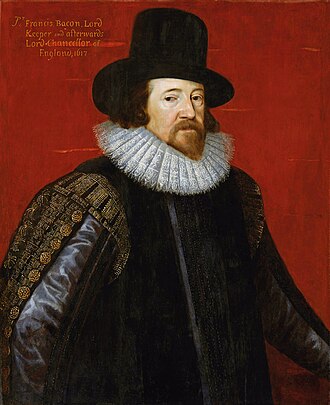
“Father of Empiricism” and of modern experimental science. Lord Chancellor of England; fell into disgrace due to corruption. His project was to renew knowledge by replacing Aristotle’s Organon with a new inductive-experimental method.
Bacon writes at the transition from the Renaissance to modernity, at a time when natural philosophy was still dominated by the Scholastic Aristotelianism transmitted through the universities. Against this tradition, he diagnoses that inherited knowledge had become sterile: highly skilled at disputing and classifying, yet incapable of producing useful works or of extending human dominion over nature. The central problem, for Bacon, was not a lack of intelligence but the lack of a correct method. Aristotle’s syllogistic logic, on his reading, merely rearranges the confused notions already contained in words, without guaranteeing that those notions correspond to things; it therefore serves to win debates, not to discover new truths about the world. In response, Bacon proposes a “Great Instauration” (Instauratio Magna) of knowledge — a fresh start grounded in ordered experience and methodical observation rather than in the authority of the ancients.
The heart of his project is to replace the mere accumulation of facts and deductive reasoning with a careful induction that ascends gradually from particular instances to the most general axioms, constantly testing and correcting its conclusions against experience. First, however, the mind must be purified of the idols — the deep-rooted prejudices that distort judgment. This combination of a critique of error and a positive method made Bacon one of the founding figures of modern science: although he himself made no great experimental discoveries, his advocacy of knowledge directed toward the benefit of humanity, of organized collaboration among investigators, and of experience as the arbiter of knowledge directly inspired the program of the Royal Society and left a deep mark on the Enlightenment. The famous formula that knowledge is power condenses this conviction: to understand natural causes is, at the same time, to gain the power to transform the world for the good of humankind.
Key Concepts
- Idols (obstacles to knowledge): of the tribe (general human defects), of the cave (individual prejudices), of the marketplace (deceptions of language), of the theater (false philosophical doctrines)
- New inductive method: three tables (presence, absence, degrees) + elimination of false hypotheses → “first vintage”
- “Knowledge is power”: science and dominion over nature coincide
- Anticipations vs. interpretations of nature: only interpretations (via correct method) are legitimate knowledge
Influenced by
- William of Ockham — nominalism, elimination of superfluous entities
- Aristotle — but he criticizes and surpasses him
Influenced
- Locke — tabula rasa and empiricism
- Hume — induction as basis of knowledge
- Newton — rules of philosophizing
- Foundation of the Royal Society (1660) — Baconian program
Works
Novum Organum (1620); New Atlantis (1627, scientific utopia); The Advancement of Learning (1605).
See also
Rationalism and Empiricism