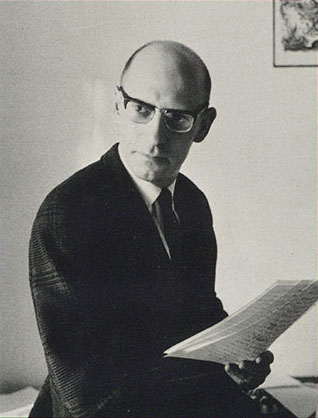
Michel Foucault was born in Poitiers in 1926 and trained at the École Normale Supérieure, where his teachers included Jean Hyppolite and Louis Althusser. A psychologist by training as well as a philosopher, from 1970 he held the chair of “History of Systems of Thought” at the Collège de France and was a politically engaged intellectual — above all in the struggle for prison reform. He became one of the most cited figures in the human sciences worldwide. He died in Paris in 1984 of an AIDS-related illness.
More than a system, Foucault developed a method for investigating how each era defines what counts as truth, normality, and knowledge. In his “archaeological” phase (The Order of Things, 1966), he analyzes the epistemes — the historical structures that delimit what can be said and thought. He then, inspired by Nietzsche, adopts genealogy: a history of practices that exposes the contingency of what appears natural, refusing pure origins and eternal essences.
His most influential thesis is the inseparability of power and knowledge. Against the idea that power is mere repression, Foucault shows that it is productive: it fabricates subjects, normalizes conduct, organizes bodies. In Discipline and Punish (1975), he analyzes the discipline of prisons, schools, and hospitals, with the panopticon as the diagram of modern surveillance; in The History of Sexuality (1976), he formulates the concept of biopower — the management of the life of populations. His work has become an inescapable reference for gender studies (Judith Butler), postcolonial studies, and an entire critical sociology of institutions.
Key Concepts
- Archaeology of Knowledge: method of analysis of epistemes — the historical conditions that determine what can be said and thought in each era (The Order of Things, 1966)
- Genealogy (after Nietzsche): history of practices of power, without pure origin — reveals the contingency and arbitrariness of what appears natural
- Discourse: set of practices that produce objects of knowledge; not merely a reflection of reality, but formative of it
- Power/Knowledge: power and knowledge are inseparable; power is not merely repressive, but productive — it produces subjects, normalizes behaviors
- Discipline (Discipline and Punish, 1975): prisons, hospitals, schools, armies use disciplinary techniques (surveillance, normalization, examination) to make bodies docile
- Biopower and Biopolitics (History of Sexuality, 1976): modern power operates on the life of populations, not merely on individuals — management of health, sexuality, natality
Influenced by
- Nietzsche — genealogy and critique of morality
- Heidegger — questioning of the subject
- Georges Canguilhem — history of sciences
- Georges Bataille — transgression and limit
Influenced
- Queer Theory (Judith Butler)
- Postcolonial Studies
- Giorgio Agamben (biopolitics)
- Gender and Sexuality Studies
- Sociology of Institutions
Works
History of Madness (1961); The Order of Things (1966); The Archaeology of Knowledge (1969); Discipline and Punish (1975); History of Sexuality (3 vols., 1976–1984).
See also
Twentieth-Century Philosophy