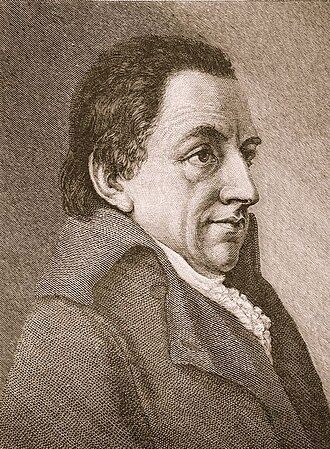
First post-Kantian to overcome the thing-in-itself. Founder of German Idealism; first rector of the University of Berlin (1811). The Addresses to the German Nation (1808) made him a symbol of German cultural nationalism.
Of humble origins, Fichte came to philosophy through his reading of Kant, which he described as an intellectual liberation. His first work, published anonymously in 1792, was taken by the public to be a writing of Kant himself; once the misunderstanding was cleared up, his reputation was secured, and in 1794 he took the chair of philosophy at Jena, then the most vibrant center of German thought. There he developed the Doctrine of Science (Wissenschaftslehre), an attempt to refound the whole of critical philosophy upon a single unconditioned principle — the Ego — and to eliminate the dogmatic residue that, in his view, the Kantian thing-in-itself still retained.
Fichte’s central problem is that of freedom: how can the autonomy of the moral subject be reconciled with a world of objects that seems to impose external limits upon it? His answer reverses the usual relation between knowing and being — we do not begin from given things that we later come to know, but from an original activity of the Ego that, in positing itself, also posits that which limits it. To know and to act are, at bottom, the same gesture. This primacy of practical action over theoretical contemplation became the hallmark of Fichtean idealism and opened the way to the theme of praxis. His career at Jena was cut short in 1799 by the so-called “atheism dispute” (Atheismusstreit), an accusation that led him to leave the university and move to Berlin, where he recast the system in an increasingly religious key. His influence on Schelling, Hegel, and later on the young Marx makes him the decisive link between Kant and the idealism that followed.
Key Concepts
- Pure Ego as absolute principle: the Ego is not a thing, it is act — free self-positing. Esse sequitur operari: being is the product of acting
- First thesis: the Ego posits itself (freedom, thesis)
- Second thesis: the Ego opposes to itself a Not-Ego (the world as necessary obstacle to freedom)
- Third thesis: Ego and Not-Ego mutually limit each other (synthesis → determined reality)
- Doctrine of Science: system of knowledge grounded in the Ego as unconditioned condition
- Late phase: the Ego is manifestation of God — mysticism of the Absolute
Influenced by
- Kant — transcendental subject; overcomes the thing-in-itself
- Rousseau — freedom as foundation
Influenced
- Schelling — departs from Fichte’s subjective idealism
- Hegel — overcomes Fichte with the Absolute as process
- Marx — praxis as human self-creation
Works
Foundations of the Doctrine of Science (1794); The Vocation of the Scholar (1794); Addresses to the German Nation (1808).
See also
German Idealism