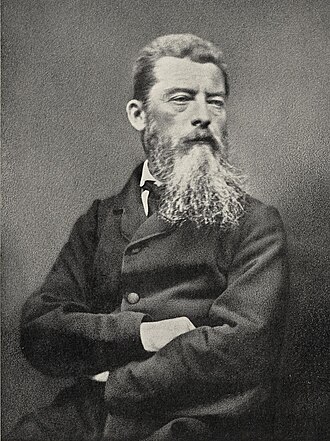
German philosopher; dissident disciple of Hegel. His materialist and anthropological critique of religion was the fundamental link between Hegelian idealism and Marx’s historical materialism. He inverted Hegel by dissolving theology into anthropology: the real subject of philosophy is not the Spirit, but sensible man.
Feuerbach first studied theology before turning to philosophy and attending Hegel’s lectures in Berlin. He gradually broke with his master: his academic career was blocked by heterodox writings on immortality, and he ended up living apart from the universities, writing from private life. It was in this context that he published his most famous work, devoted to the essence of Christianity, which had an immediate impact on a whole generation of young German intellectuals and made him the central figure of what came to be called Left Hegelianism. The starting point of his thought is a methodical operation he himself describes as an inversion: where idealist speculation makes thought, the Spirit, or God the subject and concrete man the mere predicate, Feuerbach proposes to reverse the roles and recognise in sensible, corporeal, finite man the true subject of which those concepts are projected predicates.
From this inversion follows the core of his doctrine: religion is not simply a lie to be denounced, but the distorted expression of a truth about man himself. By attributing to a transcendent being humanity’s highest attributes — love, reason, will — the human being alienates from himself what is most his own and comes to worship as divine what is, at bottom, his own species-essence. The philosopher’s task is to lead these predicates back to their true subject, recovering for man what theology had transferred to heaven. This materialist anthropology did not remain without consequences: Marx and Engels recognised in it a decisive liberation from idealism, even as they reproached it for remaining abstract and contemplative, unable to pass from the critique of religious consciousness to the practical transformation of the social conditions that produce it.
Key Concepts
- Critique of religion as alienation: God does not create man — man creates God in his own image; religion is the projection of the finest human qualities (love, wisdom, power) onto a fictional being that is separate and superior. Man impoverishes himself in enriching God
- Anthropology as theology: theology must be dissolved into anthropology; the real subject of religion is man, not God. “Homo homini Deus” — man is the god of man
- Materialist sensualism: against Hegel’s idealism, reality begins in the sensible, in the corporeal, in the natural; consciousness is a function of matter, not the reverse
- Intersubjectivity: the “I” exists only in relation to the “thou”; human essence is fundamentally social and dialogical — precursor of personalism and the ethics of recognition
- Critique of Hegel: Absolute Spirit is mystification — it is real man abstracted and inverted; philosophy must descend from heaven to earth
Influenced by
- Hegel — dialectics (but inverted: matter precedes spirit)
- Spinoza — monism and immanence
- Enlightenment sensualism (Condillac, La Mettrie)
Influenced
- Marx — Theses on Feuerbach (1845): Marx surpasses Feuerbach; the critique of religious alienation must become a critique of material alienation
- Engels — dialectical materialism
- Bruno Bauer, Max Stirner — Young Hegelians
- Nineteenth-century humanistic atheism
Works
The Essence of Christianity (1841); Principles of the Philosophy of the Future (1843); The Essence of Religion (1845); Lectures on the Essence of Religion (1851).
See also
Nineteenth-Century Philosophy