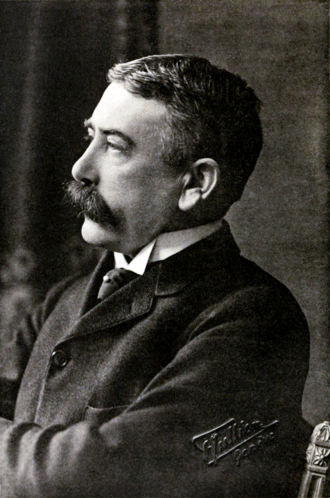
Ferdinand de Saussure (26 November 1857, Geneva — 22 February 1913, Vufflens-le-Château) was a Swiss linguist, regarded as the father of modern linguistics and the theoretical wellspring of twentieth-century structuralism. Trained in the comparative tradition of Leipzig among the Neogrammarians, at the age of 21 he published the Mémoire sur le système primitif des voyelles dans les langues indo-européennes (1878), in which he postulated, on grounds of pure systemic coherence, “sonant coefficients” whose reality would be confirmed only decades later with the decipherment of Hittite (the laryngeals). He taught in Paris and, from 1891, in Geneva, where he delivered a course in general linguistics three times (1907; 1908–09; 1910–11). He published little in his lifetime; his decisive work is posthumous.
The Course in General Linguistics (Cours de linguistique générale, 1916) was reconstructed by Charles Bally and Albert Sechehaye from students’ notebooks — Saussure left almost nothing written on the subject. This matters for rigor: the celebrated formulas “of Saussure” reach us through an editorial text, and the later publication of his own manuscripts (Writings in General Linguistics, 2002) showed that some emphases of the Course are the editors’ own.
Key Concepts
- Langue and parole: language (langage) as a human faculty splits into langue — the shared, virtual, social system that is linguistics’ proper object — and parole — the individual act of speech, its concrete realization. Langue is the social part of language, external to the individual, who can neither create nor alter it alone.
- The linguistic sign: the sign joins not a thing to a name but a signified (signifié, the concept) to a signifier (signifiant, the sound-image). It is a two-sided psychological entity, the two faces inseparable as the recto and verso of a sheet of paper.
- Arbitrariness of the sign: there is no natural bond between signifier and signified — nothing in the sounds of ox ties them to the animal. The sign is arbitrary (motivated only by convention) and the signifier is linear (it unfolds in time).
- Value and difference: the meaning of a term is not a positive substance but results from its place in the network of oppositions. As the Course puts it, “in language there are only differences, without positive terms”: each sign is what the others are not.
- Synchrony and diachrony: linguistics may study a language as a state (synchrony) or in its evolution over time (diachrony). Saussure granted methodological primacy to the synchronic description of the system.
- Syntagmatic and associative relations: signs combine in a chain (syntagmatic relation) and call one another up by likeness outside discourse (associative, later “paradigmatic” relation).
- Semiology: Saussure projected a general science of signs in social life, semiology, of which linguistics would be only one branch.
Influenced by
- The Leipzig Neogrammarians (Brugmann, Osthoff) — his comparative training, which he later reoriented
- Émile Durkheim — the notion of the social fact (a debated affinity) illuminating the social character of langue
- William Dwight Whitney — the conventional conception of language
Influenced
- The Prague Linguistic Circle (Roman Jakobson, Trubetzkoy) and the Copenhagen school (Hjelmslev)
- Lévi Strauss — structural anthropology
- Roland Barthes — the semiology of culture
- Jacques Lacan — the primacy of the signifier in the unconscious
- Jacques Derrida — deconstruction, in critical dialogue with Saussurean phonology
Works
Mémoire sur le système primitif des voyelles dans les langues indo-européennes (1878); Course in General Linguistics (Cours de linguistique générale, 1916, posthumous, ed. Bally and Sechehaye); Writings in General Linguistics (2002, manuscripts).
See also
Lévi Strauss, Roland Barthes, Jacques Lacan