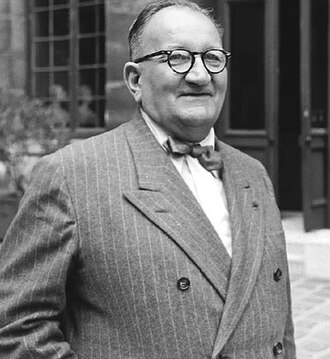
Étienne Gilson was born in Paris on 13 June 1884 and died in Cravant, in Burgundy, on 19 September 1978. Trained at the Sorbonne, where the sociologist Lucien Lévy-Bruhl was among his teachers, he defended in 1913 a thesis on freedom in Descartes and its relation to scholastic theology, which led him to study closely the medieval sources of modern thought. He taught at Lille, Strasbourg and the Sorbonne and, from 1932, held the chair of medieval philosophy at the Collège de France, which he left in 1951. He delivered the Gifford Lectures at Aberdeen in 1931–1932, published as L’Esprit de la philosophie médiévale (1932). In 1929 he helped found the Institute of Mediaeval Studies in Toronto (later the Pontifical Institute of Mediaeval Studies), where he taught for long periods. He was elected to the Académie française in 1946.
Gilson combined historical scholarship with a philosophical thesis of his own: reading Thomas Aquinas, he argued that the originality of Thomist metaphysics lies in treating being (esse) as the act of existing rather than as mere essence.
Key Concepts
- Existential Thomism — the reading according to which, in Thomas Aquinas, esse (the act of being) is prior to and irreducible to essence; later tradition is said largely to have “forgotten” this primacy and fallen back into essentialisms (set out in L’être et l’essence, 1948, and Being and Some Philosophers, 1949).
- Christian philosophy — the thesis that Christian revelation, without being confused with reason, gave medieval philosophy problems and orientations that reason alone had not formulated; the theme was debated with French historians and philosophers in the early 1930s (among them Émile Bréhier and Léon Brunschvicg) and is central to L’Esprit de la philosophie médiévale.
- Metaphysics of Exodus — a phrase associated with reading Exodus 3:14 (“I am who am”) as the basis of a metaphysics of being that identifies God with the pure act of existing.
- Methodical realism — in Le réalisme méthodique (1935) and Réalisme thomiste et critique de la connaissance (1939), he argued that realism starts from the knowledge of being and cannot be grounded by the Cartesian method, which begins from thought; hence his criticism of attempts to start from the transcendental subject, among them that of Joseph Maréchal.
- Unity of philosophical experience — in The Unity of Philosophical Experience (1937), the idea that the history of philosophy displays a regularity in which certain metaphysical choices yield comparable consequences, so that errors recur.
Influenced by
- Thomas Aquinas, his main systematic reference
- Duns Scotus, Avicenna and Bonaventure, studied in historical monographs (such as La philosophie de saint Bonaventure, 1924, and Jean Duns Scot, 1952)
- René Descartes, the object of his historical training and a permanent critical interlocutor
- Lucien Lévy-Bruhl, his teacher at the Sorbonne
Influenced
- The twentieth-century revival of medieval studies, especially through the Pontifical Institute of Mediaeval Studies in Toronto
- Scholars formed in the Toronto orbit, such as Anton Pegis, Armand Maurer and Joseph Owens
- The debate over the relation between philosophy and theology and over the notion of “Christian philosophy”
- Later existential Thomism, which adopted the distinction between essence and act of being as a key to reading Aquinas
Works
La liberté chez Descartes et la théologie (1913); Le Thomisme (1919); La philosophie de saint Bonaventure (1924); Introduction à l’étude de saint Augustin (1929); L’Esprit de la philosophie médiévale (1932); The Unity of Philosophical Experience (1937); Réalisme thomiste et critique de la connaissance (1939); L’être et l’essence (1948); Being and Some Philosophers (1949); Jean Duns Scot (1952); History of Christian Philosophy in the Middle Ages (1955).
See also
Jacques Maritain, Antonin Sertillanges, Joseph Maréchal, Josef Pieper, Saint Augustine