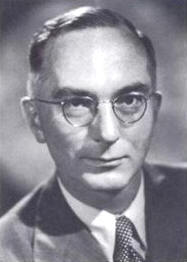
Eric Voegelin was born in Cologne, Germany, on 3 January 1901 and died in Stanford, California, on 19 January 1985. Raised in Vienna, he took his doctorate there in 1922 under Hans Kelsen and Othmar Spann, and taught at the University of Vienna until the Anschluss of 1938, when he emigrated to the United States. He taught at Louisiana State University (1942–1958), returned to Germany to hold the chair of political science at the University of Munich (1958–1969), and spent his last years at the Hoover Institution at Stanford.
Voegelin broke with the methodological positivism of his formation, in particular with the rigid separation of fact and value, and proposed a political science oriented to the “experience of order”: the inquiry into how societies interpret themselves through symbols expressing their relation to transcendence. This orientation runs through his work, from The Political Religions (1938) to Order and History.
Key Concepts
- Modern Gnosticism — in The New Science of Politics (1952), originally the Walgreen Lectures at Chicago, Voegelin interprets movements such as progressivism, positivism, Marxism, and National Socialism as variants of a Gnostic impulse: the conviction that the world is defective and can be saved by human knowledge and action.
- Immanentizing the eschaton — a formulation associated with Voegelin for the attempt to realize within history the eschatological fulfillment that Christian tradition places beyond it; what tradition reserved for transcendence is projected onto intramundane political programs.
- Representation — the New Science distinguishes elemental (legal) representation from existential and transcendental representation, in which society becomes representable through symbols that order it in relation to the ground of being.
- Experiences and symbolization — civilizations express experiences of order through “compact” symbols (myth) or “differentiated” ones (philosophy, revelation); in Order and History (1956–1987) he traces this differentiation in Israel, Greece, and the imperial cosmos, with the notion of the “leap in being.”
- The In-Between (metaxy) — recovered from Plato, it designates the human condition as tension between immanence and transcendence, finite and infinite.
- Anamnesis — the recollection of consciousness of itself and of its openness to transcendence, the theme of Anamnesis (1966).
- Second reality — Voegelin’s term for the ideological construction that replaces lived reality with a closed image.
Criticism
Historians of ancient Gnosticism contest his broad use of the term and its extension to modernity. Hans Blumenberg, in The Legitimacy of the Modern Age, rejected the thesis that modernity is a revival of Gnosticism. Others point to the normative and theological character of his diagnosis, which makes it hard to falsify, and to the difficulty of fitting very different historical movements under one category. There was also a polemic with Hannah Arendt over The Origins of Totalitarianism, in an exchange published in the Review of Politics (1953).
Influenced by
- Plato and Aristotle — order of the soul and order of the city, metaxy
- Saint Augustine — the symbolic and historical dimension of order
- Bergson — the openness of consciousness to transcendence, in his readings
- Hans Kelsen — his doctoral supervisor, from whom he distanced himself by rejecting legal positivism
Influenced
- Reception in political science and political theology, especially in the American conservative tradition
- Studies of political religions and totalitarianism
- Dialogue with Leo Strauss, with whom he kept an extensive correspondence
Works
Die politischen Religionen (1938); The New Science of Politics (1952); Order and History (5 vols.: Israel and Revelation, 1956; The World of the Polis, 1957; Plato and Aristotle, 1957; The Ecumenic Age, 1974; In Search of Order, 1987); Wissenschaft, Politik und Gnosis (1959; Science, Politics and Gnosticism, 1968); Anamnesis (1966).
See also
Plato, Hans Kelsen, Leo Strauss, Hannah Arendt, Carl Schmitt, Saint Augustine