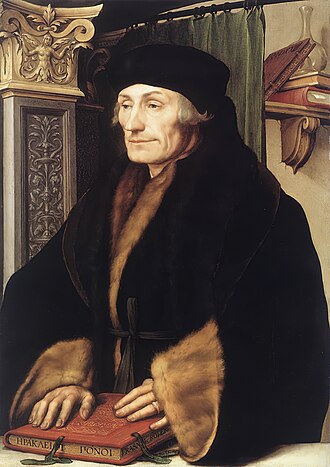
Born in Rotterdam around 1466, Erasmus (Desiderius Erasmus of Rotterdam) was the greatest humanist of the Northern Renaissance — the “Prince of the Humanists.” An Augustinian canon and priest, he devoted himself to letters and traveled across Europe, forming a friendship with Thomas More in England. An incomparable scholar of Greek and Latin, he made cultivated language an instrument of reform and of irony. He died in Basel in 1536, having refused both the dogmatism of the old Church and the Protestant rupture.
His ideal is Christian humanism: to unite classical wisdom with the message of the Gospel, in a “philosophy of Christ” (philosophia Christi) understood as interior, simple, and ethical piety — not as ritual or empty erudition. Hence his motto “ad fontes” (“to the sources”): to return to the original texts, biblical and patristic, against the pedantry of decadent scholastic theology. His critical edition of the New Testament in Greek (1516) was a philological landmark — and, without his intending it, gave ammunition to the Protestant reforms.
His most famous work, the Praise of Folly (1511), dedicated to More, is a biting satire of human foolishness that spares neither monks, theologians, popes, nor kings. Yet when Luther broke with Rome, Erasmus refused to follow him: in the debate on free will (1524), he defended human freedom and cooperation with grace, against the Lutheran thesis of the enslaved will. A moderate and pacifist spirit in an age of fanaticism, Erasmus influenced Montaigne and became an enduring symbol of tolerance and dialogue.
Key Concepts
- Christian humanism: reconciling the classical ideal (rhetoric, wisdom, paideia) with the Gospel; authentic piety (philosophia Christi) is interior, not ritualistic
- Praise of Folly (Moriae Encomium, 1511): brilliant satire of human foolishness — priests, popes, theologians, kings are ridiculous; but the greatest folly is worldly wisdom that loses the simple Gospel
- Critique of scholasticism: medieval theology became pedantic and empty; one must return to the sources (ad fontes) — original biblical and patristic texts
- Pacifism: he fought against war as contrary to the Gospel; The Complaint of Peace (1517)
- Free will: against Luther and Calvin’s irresistible grace; human freedom cooperates with divine grace (On Free Will, 1524)
- Edition of the New Testament in Greek (1516): textual philological criticism — basis of Protestant reforms, although it was not his intention
Influenced by
- Plato and the Stoics — classical moral philosophy
- Saint Augustine and Church Fathers — patristic theology
- Lorenzo Valla — humanist philology
- Thomas More — friendship and humanism
Influenced
- Luther — (indirectly, through Church criticism) but opposed the Reformation
- Montaigne — moderate skepticism and practical wisdom
- Later Christian humanism (Juan Luis Vives)
- Ecumenism and Catholic reformism (Trent)
Works
Praise of Folly (1511); Adages (1500–1536); New Testament in Greek (1516); Enchiridion of the Christian Soldier (1504); On Free Will (1524).
See also
Humanism and Renaissance