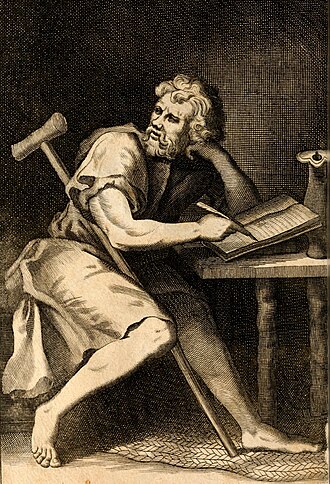
Phrygian ex-slave; the Stoic who most lived what he preached. His central distinction structures all Stoic ethics: what depends on us (eph’ hêmin: thoughts, impulses, judgments, desires) vs. what does not depend on us (ouk eph’ hêmin: body, fame, wealth, health). Inner freedom is absolute and cannot be taken by any master. “Bear and forbear” (anékhou kai apékhou).
Born in Hierapolis, in Phrygia (modern Turkey), Epictetus spent his early years as a slave in Rome, in the service of Epaphroditus, a freedman connected to Nero’s court. It was in this setting that he studied under the Stoic Musonius Rufus, from whom he inherited the conviction that philosophy is worth only as much as it transforms conduct. He is said to have been lame — a condition he reportedly mentioned with serene indifference, a living example of his doctrine that disability touches the body, not the prohairesis, the will that chooses. Freed later in life, he devoted himself to teaching in Rome until the emperor Domitian expelled the philosophers from the city; he then moved to Nicopolis, in Epirus (northwestern Greece), where he founded a school that drew disciples from far and wide, including young men of the Roman elite.
His philosophy is eminently practical: he built no metaphysical system and did not occupy himself with abstract logic, but concentrated his whole effort on ethics as exercise. The starting point is the recognition that suffering arises not from events but from the judgments we make about them — a thesis he sums up in the formula that it is not things that disturb us, but our opinions about them. The sage’s task is therefore to align desire with what lies within his control and to accept the rest as part of the rational order of the cosmos. This pedagogy of serenity, transmitted orally and recorded by his disciple Arrian, has crossed the centuries: it directly inspired the Meditations of Marcus Aurelius, nourished Christian and monastic spirituality, and reemerges in the twentieth century as one of the philosophical roots of the cognitive therapies, which revive the idea that to reeducate judgment is the path to reeducating emotion.
Key Concepts
- Dichotomy of control: what depends on us vs. what does not depend on us
- Inner freedom as the only true freedom
- Prohairesis: the faculty of rational choice — sole complete good
- Philosophy as a way of life, not abstract theory
Influenced by
- Zeno of Citium — Stoic doctrine
- Socrates — self-examination
Influenced
- Marcus Aurelius — Meditations are notes of Stoic practice inspired by Epictetus
- Contemporary cognitive psychology (rational-emotive therapy by Ellis)
Works
He did not write. Arrian (disciple) recorded: Enchiridion (Manual); Discourses (8 books, 4 preserved).
See also
Hellenistic Philosophy